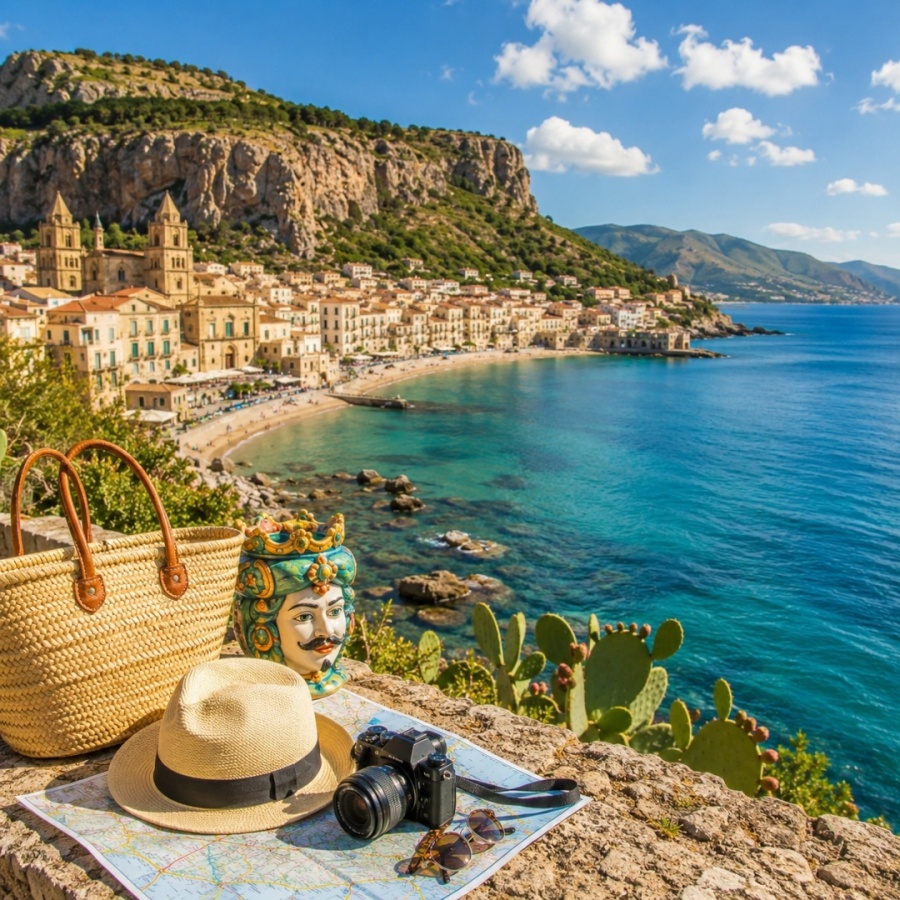
Sicily Travel Guide: Practical Tips for Planning Your First Trip
Sicily Travel Guide: Practical Tips for Planning Your First Trip
Planning a trip to Sicily sounds romantic, exciting and slightly cinematic.
And it is.
But it is also a journey to an island where the roads have opinions, lunch can last longer than expected, distances look shorter on a map than they feel in real life, and “we’ll just improvise” can quickly become a full-time logistical project.
Sicily is one of the most rewarding places in Italy for curious travelers. It has ancient Greek temples, active volcanoes, baroque towns, wild coastlines, mountain villages, wine roads, family-run trattorias and landscapes that seem to change personality every forty minutes.
It is also not a theme park version of Italy.
Sicily is real, layered, intense, beautiful, imperfect and wonderfully alive. That is exactly why it is worth visiting and exactly why planning matters.
This guide is designed for first-time visitors planning a trip to Sicily, whether you are arriving from Europe, North America, Australia or anywhere else curious enough to cross the Mediterranean for volcanoes, ruins and suspiciously good food.
It covers the practical things you should know before you arrive, so you can spend less time being confused by parking signs and more time enjoying cannoli, lava landscapes and sunsets that look almost offensively beautiful.
Why Sicily Is Different from Mainland Italy
Same country, different rhythm
Many travelers arrive in Sicily after visiting Rome, Florence, Venice or the Amalfi Coast. That can create certain expectations.
Sicily will politely ignore them.
The island has its own rhythm, history, food culture, climate, landscape and sense of time. It is part of Italy, of course, but it has also been shaped by Greeks, Romans, Byzantines, Arabs, Normans, Spanish rulers and centuries of Mediterranean exchange.
The result is not simply “southern Italy.”
It is Sicily.
That means you may find Greek temples beside almond trees, Arab-influenced street food, Norman cathedrals with golden mosaics, Spanish baroque towns and an active volcano casually smoking in the background.
Subtle, Sicily is not.
Expect beauty, but also complexity
Sicily is not always polished. Some roads are rough. Public transport can require patience. Opening hours may be seasonal. Small towns can be sleepy in the afternoon. Parking can feel like an intellectual puzzle designed by someone with a dark sense of humor.
But this is part of the island’s authenticity.
The reward is a destination that still feels alive, local and deeply connected to its own identity. Sicily is not trying too hard to become convenient. It is busy being itself.
Which, honestly, is one of its greatest strengths.
Passports, Visas and Entry Rules
Check the basics before booking
Entry rules for Italy depend on your nationality, passport, length of stay and purpose of travel. Many visitors can enter Italy for tourism without applying for a traditional visa in advance, while others may need specific documentation before departure.
That sounds simple, and mostly it is.
But simple does not mean “ignore it until the night before your flight.”
Before booking, check that your passport is valid, in good condition and compliant with the entry requirements that apply to your country of citizenship. Also remember that European travel rules can change, and new travel authorization systems may apply depending on when you travel.
If you are planning a longer stay, working remotely, studying, joining family or doing anything more complicated than a regular vacation, check the official requirements carefully before assuming everything will be fine because “it’s just Italy.”
Italian bureaucracy does not respond emotionally to optimism.
Travel authorization and official sources
Some non-European travelers may need an electronic travel authorization or additional entry requirements in the future. Before your trip, always check official government or European Union sources rather than relying only on travel blogs, social media or that one person who visited Sicily in 2014 and now considers themselves a geopolitical expert.
Travel paperwork is rarely exciting.
But missing it is considerably less exciting.
Best Time to Visit Sicily
Spring and autumn are usually ideal
For most visitors, the best times to visit Sicily are spring and autumn.
April, May, early June, September and October often offer a very good balance of pleasant weather, active towns, open attractions and more comfortable temperatures.
Spring brings wildflowers, green countryside and excellent conditions for walking tours, archaeological sites and Mount Etna excursions. Autumn brings warm sea temperatures, softer light, harvest season, wine experiences and fewer crowds than peak summer.
In other words, the island is still beautiful, but less determined to roast you alive.
Summer is beautiful, but intense
July and August are popular, lively and very hot. They are great for beach vacations, island hopping and late evenings outdoors.
They are less ideal for long city walks at midday, ambitious archaeological visits under full sun or pretending that your linen shirt is a full climate-control system.
If you travel in summer, plan early starts, afternoon breaks and plenty of water. Sicilian summer is not shy.
Winter can be surprisingly rewarding
Winter in Sicily is quieter and more local. Coastal towns may feel sleepy, but cities such as Catania, Palermo, Syracuse and Taormina still have life, culture and food worth crossing borders for.
Mount Etna can have snow in winter, which surprises visitors who imagined Sicily as a permanent postcard of beaches and lemons.
The island enjoys proving people wrong.
How Long Should You Stay in Sicily?
One week is good, ten days is better
Try not to squeeze Sicily into three rushed days between Rome and the Amalfi Coast.
Technically, you can do it.
Emotionally, Sicily may judge you.
A week allows you to see one side of the island reasonably well, especially eastern Sicily or western Sicily. Ten to fourteen days gives you a much better chance to combine cities, nature, beaches, archaeological sites, wine regions and slower countryside experiences.
Do not underestimate travel times
Sicily looks compact on a map, but getting around takes time. Roads can be winding, traffic around cities can be slow, and small-town routes are not always designed for people trying to optimize their vacation like a spreadsheet.
A common mistake is trying to visit Palermo, Taormina, Mount Etna, Syracuse, Agrigento, Cefalù, Noto, Ragusa and the Aeolian Islands in one week.
This is not an itinerary.
It is a cry for help.
Choose fewer bases and explore better.
Where to Stay: Eastern Sicily or Western Sicily?
Eastern Sicily for first-time visitors
For many first-time visitors, eastern Sicily is the easiest introduction to the island.
This side includes Catania, Mount Etna, Taormina, Syracuse, Ortigia, Noto, Ragusa and the Val di Noto baroque towns.
It is ideal if you want a mix of volcano, sea, ancient history, elegant towns, food, wine and guided excursions.
It is also the side where Mount Etna appears constantly, as if casually reminding everyone who the main character is.
Western Sicily for food, coast and cultural depth
Western Sicily offers Palermo, Monreale, Cefalù, Trapani, Erice, Segesta, Selinunte, Marsala and the Zingaro Nature Reserve.
This side is excellent for travelers interested in Arab-Norman heritage, street food, dramatic coastlines, archaeological parks and a slightly less “classic first trip” experience.
Palermo alone can make you question everything you thought you knew about Italian cities.
Usually while feeding you very well.
Do both only if you have enough time
Combining east and west is possible and rewarding, but it works best with at least ten days, preferably more.
If you have only six or seven nights, it is usually better to focus on one side instead of spending too much of your vacation inside a car, staring at road signs and wondering why you did this to yourself.
Flying to Sicily
Main airports
Sicily has two main international gateways: Catania Airport on the east coast and Palermo Airport on the north-western side.
Catania is usually the most convenient airport for Mount Etna, Taormina, Syracuse, Noto and eastern Sicily.
Palermo is usually better for Palermo itself, Cefalù, western Sicily, Trapani, Marsala, Erice and the Zingaro area.
Many travelers reach Sicily by connecting through major Italian or European hubs such as Rome, Milan, Munich, Frankfurt, Paris, Amsterdam, London or other seasonal routes. Direct flights from some European cities are common in warmer months, while intercontinental visitors usually connect somewhere before reaching the island.
Your luggage may get a more complicated European tour than you do.
Pack essentials in your carry-on.
Arrive with realistic energy
Jet lag, early departures and long travel days are real. So is Sicilian traffic.
If you arrive after a long journey, avoid planning a demanding first day. Do not land, rent a car, drive three hours, hike a volcano and then wonder why your soul has left your body.
Start gently. Walk, eat, sleep, adjust.
Sicily will still be there tomorrow, probably with better lighting.
Renting a Car in Sicily
A car is often useful, but not always relaxing
For many Sicily itineraries, renting a car is the most flexible option. It allows you to reach beaches, wineries, mountain towns, archaeological sites and natural areas that are difficult or slow to access by public transport.
However, driving in Sicily is not the same as driving in a quiet suburb, a perfectly organized Alpine village or a motorway service brochure.
Roads can be narrow. Parking can be creative. Scooters behave as if physics is a suggestion. Local drivers may communicate through gestures, eye contact and a spiritual interpretation of lane markings.
You can absolutely drive in Sicily.
Just do not expect calm Scandinavian road choreography.
Choose the right car
Rent a smaller car than you think you need. Historic centers, village streets and parking spaces often punish excessive confidence.
A large SUV may feel comforting on the highway, but less charming when you are trying to pass through a medieval street that appears to have been designed for a donkey with excellent spatial awareness.
Automatic cars are available but often cost more and may need to be booked in advance.
Watch for ZTL zones
Many Italian cities have restricted traffic zones called ZTL. Driving into one without authorization can result in fines, often delivered later when you are peacefully back home and emotionally unprepared.
Check with your hotel before driving into a historic center. When in doubt, park outside and walk.
Your wallet will thank you.
Public Transport in Sicily
Useful, but not always enough
Trains and buses connect many Sicilian towns and cities, but public transport is not always ideal for remote beaches, rural areas, wineries, mountain villages or nature trails.
It can work well for city-to-city travel, especially if your itinerary focuses on major destinations.
But if you want to explore the countryside, Mount Etna, small villages or hidden corners, you may need a car, private transfer or guided tour.
Public transport in Sicily can be charming.
It can also be an exercise in character development.
Train travel basics
Trains can be useful between some cities, especially for travelers who prefer not to drive. For example, routes between Catania, Syracuse, Taormina-Giardini and Messina can be practical depending on timing.
Always check schedules carefully and do not assume late-evening connections will be convenient.
Sicily is not trying to sabotage your itinerary.
It simply has its own priorities.
Money, Cards and Cash
Credit cards are widely accepted, but carry some cash
Credit cards are widely used in Sicily, especially in hotels, restaurants, larger shops, fuel stations and tourist areas.
Still, carrying some euros is useful for small cafés, markets, parking, rural areas, tips, roadside fruit stands or places where the card machine has mysteriously decided to “not work today.”
This mystery is ancient and widely respected.
Use ATMs wisely
Use official bank ATMs when possible and avoid unnecessary currency conversion offers. If a machine or card terminal asks whether you want to pay in your home currency or euros, paying in euros is often better because your bank or card provider usually handles the exchange rate more fairly.
Travel finance is not glamorous.
But neither is discovering you paid extra because a machine sounded polite.
Tipping in Sicily
Appreciated, but not always expected
Tipping in Sicily is appreciated but not expected in the same way it is in some countries.
Restaurant staff are not generally relying on tips in the way they might elsewhere. You do not need to calculate a large percentage every time someone brings you pasta.
For good service, you can round up the bill or leave a few euros. In more formal restaurants or for excellent service, a larger tip is appreciated.
For guides, drivers and private experiences, tipping is more common, especially when the service has been personal, flexible and memorable.
Basically: tip with gratitude, not panic.
Food Culture: How to Eat Well in Sicily
Do not rush meals
Sicily is a dangerous place for people who treat food as fuel.
Meals here are part of the travel experience. Lunch may be slower than expected. Dinner often starts later than some visitors are used to. A good meal may involve several courses, local wine and a conversation about whether one grandmother’s caponata is superior to another grandmother’s caponata.
This debate may never end.
Do not fight it.
Try regional specialties
Sicilian food changes from area to area. In Palermo, street food is essential. In Catania, try pasta alla Norma, fish markets and granita. Around Mount Etna, look for pistachios, mushrooms, honey, wine and mountain products. In the south-east, almond sweets, ricotta, tomatoes and baroque pastry traditions appear with great confidence.
Do not come to Sicily only to order the same dish every night.
This is a place where curiosity is rewarded.
Usually with carbohydrates.
Breakfast may be different
Italian breakfast is usually lighter and sweeter than what some visitors expect. Coffee and a pastry are common. In Sicily, granita with brioche can also be a perfectly respectable breakfast.
Yes, frozen dessert for breakfast.
No, we are not accepting criticism.
Coffee in Sicily
Small, strong and not endlessly refillable
Coffee culture in Sicily is different from the large takeaway café model found in many countries.
An espresso is small, strong and quick. A cappuccino is usually a morning drink. Large takeaway coffees exist in some places, but they are not the center of local life.
Ordering coffee at a bar can be fast and informal. You may pay first, bring the receipt to the counter, drink standing up and leave within minutes.
This is not rude.
It is efficiency with caffeine.
Slow coffee also exists
Of course, you can sit at a table, especially in beautiful squares, seaside towns and historic centers. Just know that table service may cost more than standing at the bar.
You are not only paying for coffee.
You are renting a small piece of atmosphere.
Packing for Sicily
Pack for variety
Sicily is not one single climate experience. Coastal areas can be warm and breezy, cities can be hot, mountains can be cool, and Mount Etna can surprise visitors with wind, cold or snow depending on the season.
If your trip includes both beach towns and Etna, pack layers.
The volcano does not care that you came to Italy with only resort clothing.
Bring proper shoes
Good walking shoes are essential. Historic centers have stone streets, archaeological sites can be uneven, and nature trails require more than sandals and confidence.
For Mount Etna, closed shoes are especially important. Lava rock is not gentle. It has not been trained in hospitality.
Power adapters
Italy uses European-style electrical systems, so many visitors will need plug adapters. Many modern electronics such as phones and laptops are dual voltage, but always check your device labels. Hair dryers, curling irons and other heat-producing devices are more likely to cause problems if they are not compatible.
Nothing says “romantic Sicilian escape” like accidentally destroying your hair tool on day one.
Safety and Common Sense
Sicily is generally welcoming, but stay aware
Sicily is generally a safe destination for travelers, but normal travel awareness applies. Watch your belongings in crowded markets, train stations, beaches and tourist areas. Do not leave valuables visible in rental cars. Be careful with bags in busy places.
This is not special to Sicily.
It is basic travel survival.
Respect natural environments
If visiting Mount Etna, nature reserves, beaches or canyons, follow local rules. Do not enter closed trails, ignore volcanic restrictions, climb over barriers or assume that a dramatic selfie is worth a bad decision.
Sicily is photogenic enough without you becoming part of a rescue operation.
Phones, Internet and Navigation
Check your phone plan
Before traveling, check whether your phone plan includes data in Italy. Some plans include roaming, while others can become expensive quickly.
An eSIM or local SIM may be useful if you need reliable data for maps, messages and travel planning.
Do this before you are standing in a rental car parking lot, tired, hungry and trying to understand why your map refuses to load.
Download offline maps
Offline maps are a good idea, especially if you plan to drive in rural areas, visit nature reserves or explore mountain roads.
Phone signal in Sicily is usually fine in towns and along major roads, but it can weaken in remote areas.
Like some travel companions, it may disappear just when things get complicated.
Cultural Tips for First-Time Visitors
Slow down
One of the best things visitors can do in Sicily is slow down.
Not everything needs to be optimized. Not every lunch needs to be fast. Not every town needs to be “done” in two hours. Some of Sicily’s best moments happen when you stop chasing the itinerary and start paying attention.
A quiet square. A view of Etna. A conversation with a local. A granita at the right time of day. A road that leads somewhere unexpected.
Sicily rewards curiosity more than speed.
Learn a few Italian words
Many people working in tourism speak English, especially in popular areas. But learning a few Italian words is always appreciated.
Buongiorno. Grazie. Per favore. Un caffè, per favore.
These will not make you fluent.
But they will make you more charming, which is almost as useful.
Be flexible
Weather can change. Volcano access can change. Ferries can be delayed. Restaurants can close for vacation. A road may be under construction. A tiny village may be more interesting than the famous place you were rushing toward.
Flexibility is not a backup plan in Sicily.
It is the plan.
Should You Book Tours in Advance?
For popular experiences, yes
If you want to visit Mount Etna with a local guide, book a private excursion, arrange a winery visit, take a boat tour or visit during high season, booking in advance is strongly recommended.
Good guides, drivers and small wineries do not have unlimited availability.
Despite what some travelers believe, Sicily does not keep an emergency supply of excellent private guides hidden behind a lemon tree.
Private tours can save time
For visitors with limited vacation time, private tours can make a big difference. They reduce logistical stress, help you understand what you are seeing and allow you to experience places that are harder to manage alone.
This is especially true for Mount Etna, wine regions, countryside itineraries and mixed day trips combining nature, food and culture.
A good local guide does not just show you places.
They translate the island.
Common Mistakes First-Time Visitors Make in Sicily
Trying to see too much
The biggest mistake is overpacking the itinerary. Sicily is larger and more complex than many visitors expect. You will enjoy it more if you choose fewer places and spend more time in each.
Driving into historic centers without checking
ZTL zones, narrow streets and limited parking can create expensive or stressful surprises. Ask your accommodation before entering old town areas by car.
Underestimating heat
Summer heat can be serious. Plan outdoor sightseeing early or late, and avoid long exposed walks in the middle of the day.
Expecting everything to work like home
Service can be warm, personal and generous, but it may not always follow the timing or habits you are used to. Relax. You did not travel all this way to experience your own country with better tomatoes.
Forgetting that Sicily is not small
Distances matter. Roads matter. Terrain matters. Google Maps is helpful, but it does not always communicate emotional reality.
A Simple First-Time Sicily Itinerary
Seven nights in eastern Sicily
If this is your first trip and you have about one week, a strong eastern Sicily itinerary could include:
Days 1–2: Catania or Taormina area, depending on your arrival airport and travel style.
Day 3: Mount Etna excursion with a local guide.
Day 4: Taormina, Castelmola or the eastern coast.
Days 5–6: Syracuse and Ortigia.
Day 7: Noto or the Val di Noto, with food, wine or countryside stops.
This gives you volcano, sea, history, baroque architecture and enough time to eat properly, which should never be treated as optional.
Ten to fourteen days
With more time, you can add Ragusa, Modica, Agrigento, Palermo, Cefalù or western Sicily.
At that point, Sicily begins to reveal itself not as a destination, but as a small continent pretending to be an island.
Final Thoughts: Plan Well, Then Let Sicily Surprise You
A trip to Sicily deserves good planning.
Not rigid planning.
Good planning.
Know your entry rules, choose the right season, avoid impossible itineraries, understand driving realities, pack properly and leave space for the unexpected.
Because the unexpected is where Sicily often does its best work.
A village festival you did not know about. A view of Etna appearing between two buildings. A fisherman repairing nets. A trattoria with no dramatic design but unforgettable pasta. A road lined with stone walls, orange groves or vineyards.
Sicily is not always easy.
But it is deeply rewarding.
Come prepared, stay curious and do not try to control every minute.
The island has been welcoming, confusing and seducing travelers for centuries.
It knows what it is doing.
🌋 Planning your first trip to Sicily? Explore Mount Etna, hidden landscapes, wine roads and authentic local experiences with Etna Unlimited.
Discover private tours and local experiences in Sicily
Etna Unlimited Excursions & Tours