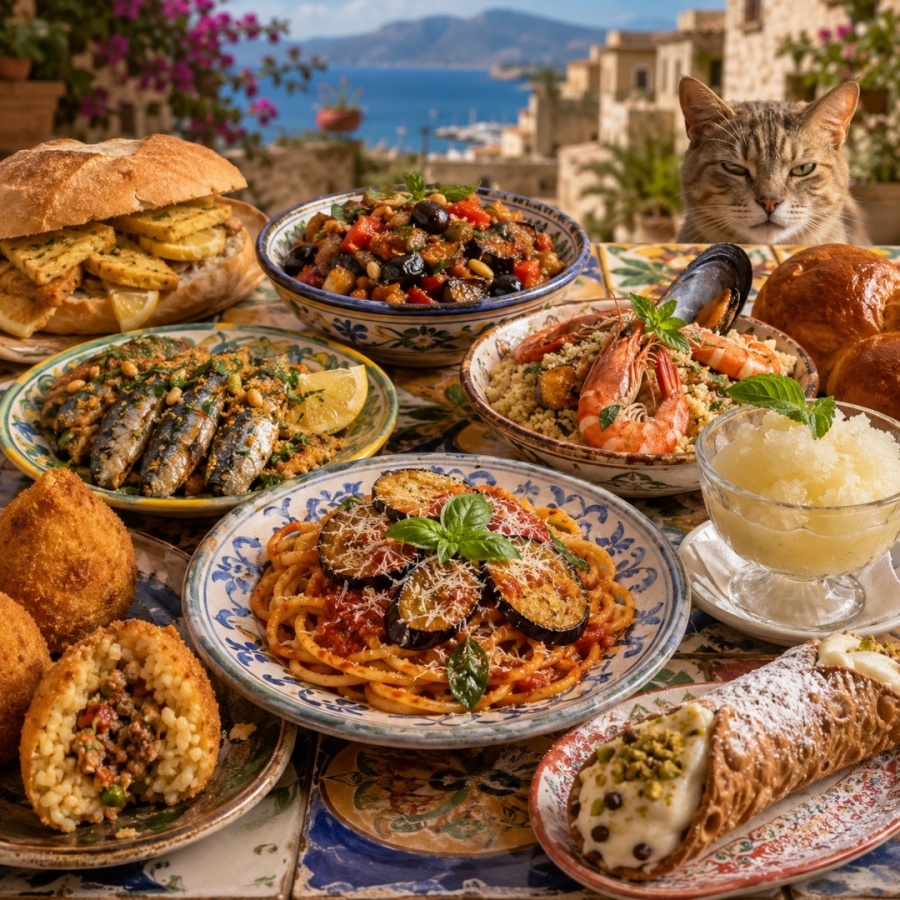
Authentic Sicilian Recipes: A Taste of Tradition
Authentic Sicilian Recipes: A Taste of Tradition
Sicily is not a place where food is simply eaten.
That would be far too casual.
In Sicily, food is discussed, defended, inherited, compared, judged, celebrated, remembered and occasionally used as evidence in family debates that began sometime around 1974 and show no sign of ending.
Every Sicilian recipe carries more than ingredients. It carries history, geography, migration, poverty, creativity, pride and the firm conviction that someone’s grandmother made it better.
Probably true.
From pasta alla Norma to caponata, from arancini to couscous, from cannoli to granita, Sicilian cuisine is a living archive of the island’s past. Greek, Roman, Arab, Norman, Spanish and Mediterranean influences have all left traces on the table, usually in ways more delicious than most history books can manage.
This guide explores some of the most authentic Sicilian recipes and the traditions behind them. It is not just about what to eat in Sicily, but why these dishes matter and why Sicilians can become surprisingly emotional about eggplants, breadcrumbs and the correct texture of ricotta.
As they should.
Sicilian Cuisine: Simple Ingredients, Complicated Feelings
A cuisine shaped by history and necessity
Sicilian food is often described as rich, colorful and generous. That is true, but it can also be misleading.
Many traditional Sicilian recipes were born from simplicity, scarcity and the need to make something memorable from what was available. Bread, vegetables, legumes, olive oil, fish, herbs, citrus, almonds, pistachios, ricotta, capers and seasonal produce form the backbone of the island’s cooking.
The magic lies in transformation.
A few eggplants become caponata. Stale bread becomes golden breadcrumbs. Sardines become a pasta dish with raisins, pine nuts and wild fennel. Ricotta becomes cannoli filling. Ice, fruit and sugar become granita, which Sicily has correctly classified as breakfast when served with brioche.
This is not just cooking.
It is practical poetry with olive oil.
The island tastes different from east to west
Sicily is one island, but its cuisine changes from province to province, sometimes from town to town, and occasionally from one side of the same street to the other if two families disagree strongly enough.
Palermo is famous for street food, panelle, sfincione and bold Arab-Norman influences. Catania is closely linked to pasta alla Norma, fish markets and granita. Trapani has couscous and seafood traditions shaped by its connection with North Africa. The south-east is known for almond sweets, ricotta, tomatoes, chocolate from Modica and baroque excess, because even dessert apparently needed architecture.
Authentic Sicilian food is not one fixed menu.
It is a mosaic.
A very edible mosaic.
Pasta alla Norma: Catania’s Most Famous Dish
Eggplant, tomato, basil and ricotta salata
If Catania had to choose one dish to represent itself, it would almost certainly be pasta alla Norma.
And if another city tried to claim it, Catania would have opinions.
This classic Sicilian recipe is made with pasta, tomato sauce, fried eggplant, basil and grated ricotta salata. The ingredients are simple, but the result is deeply satisfying: sweet tomato, creamy eggplant, salty cheese and perfume from fresh basil.
The dish is traditionally associated with the composer Vincenzo Bellini and his opera Norma. Whether every detail of the story is perfectly documented is less important than the fact that Sicilians managed to connect pasta, opera and civic pride in one plate.
Efficient.
Why it matters
Pasta alla Norma is a perfect example of Sicilian cooking: few ingredients, strong identity, seasonal vegetables and a result that feels more luxurious than the ingredient list suggests.
The key is not to rush it. The eggplant should be properly fried, the sauce should taste of ripe tomato, and the ricotta salata should not be treated like a decorative afterthought.
In Sicily, cheese knows when it is being disrespected.
Caponata: Sweet, Sour and Very Opinionated
The eggplant dish that refuses to be simple
Caponata is one of Sicily’s most beloved vegetable dishes, and also one of the most debated.
At its heart, it is usually made with eggplant, celery, onion, tomato, capers, olives, vinegar and sugar. The result is sweet and sour, soft and intense, rustic and elegant at the same time.
Like Sicily, basically.
Caponata is often served as an appetizer, side dish or part of a larger spread. It is usually better after resting, because the flavors need time to become friends, argue, reconcile and finally agree to be delicious.
Every family has its version
Some versions include pine nuts. Some include raisins. Some use peppers. Some are more tomato-rich. Some are more vinegary. Some grandmothers will listen politely to your version and then quietly reject it at a spiritual level.
That is normal.
Caponata is not just a recipe. It is a worldview.
The balance between sweet and sour is the soul of the dish. Too much sugar and it becomes confused. Too much vinegar and it becomes a punishment. Done well, it is one of the greatest expressions of Sicilian vegetable cooking.
Pasta con le Sarde: Sicily in One Plate
Sardines, wild fennel, raisins and pine nuts
Pasta con le sarde is one of the great masterpieces of Sicilian cuisine.
It combines fresh sardines, wild fennel, raisins, pine nuts, saffron and breadcrumbs. At first glance, the combination may seem unusual to visitors. Fish, sweet raisins, aromatic fennel and toasted breadcrumbs in one pasta dish?
Yes.
Trust the island.
This recipe reflects the deep Mediterranean layers of Sicilian food, especially Arab influences and the island’s relationship with the sea. It is savory, sweet, aromatic and slightly mysterious, which is more or less Sicily’s preferred personality profile.
The role of breadcrumbs
In many Sicilian pasta dishes, toasted breadcrumbs are used instead of grated cheese, especially with fish-based recipes.
They add texture, flavor and a certain humble brilliance. They are sometimes called “poor man’s cheese,” which is a bit unfair because, when toasted properly with olive oil, breadcrumbs are absolutely not behaving poorly.
They are doing excellent work.
Arancini or Arancine: The Delicious Debate
Rice balls with regional identity issues
No discussion of authentic Sicilian recipes can avoid arancini or arancine, depending on where you are in Sicily and how quickly you want to start a debate.
These fried rice balls are usually filled with ragù, peas and cheese, though many variations exist. In eastern Sicily, they are often called arancini and may have a conical shape, famously associated with Mount Etna. In Palermo and western Sicily, arancine is common, often round and proudly feminine in name.
Is the difference important?
To outsiders, maybe not.
To Sicilians, please be careful.
Street food with serious dignity
Arancini are street food, but they are not casual in meaning. They are portable, filling, golden and deeply comforting. They represent Sicily’s ability to turn rice, sauce, cheese and frying oil into something that feels like both lunch and destiny.
A good arancino should be crisp outside, flavorful inside and hot enough to remind impatient people that enthusiasm has consequences.
Panelle: Palermo’s Chickpea Genius
Simple, cheap and perfect
Panelle are one of Palermo’s most iconic street foods. Made from chickpea flour, water, salt and parsley, the mixture is cooked, spread thin, cut into slices and fried until golden.
Then, because Palermo understands happiness, the panelle are often served inside bread.
Carbohydrates inside carbohydrates.
A philosophical position.
Panelle are simple, inexpensive and deeply satisfying. They are proof that Sicilian street food does not need luxury ingredients to be unforgettable.
A food of the people
Panelle belong to Palermo’s popular food culture, where humble ingredients become something fast, flavorful and democratic. They are often served with a squeeze of lemon and eaten standing, walking or while pretending you were only going to have one.
Nobody believes you.
Sfincione: Palermo’s Soft, Serious Street Pizza
Not pizza, not focaccia, very Sicilian
Sfincione is often described as Sicilian pizza, but that does not quite capture it.
It is thick, soft, spongy and topped traditionally with tomato, onion, anchovies, oregano, breadcrumbs and caciocavallo cheese. It is deeply associated with Palermo and is one of the city’s great street foods.
The name is connected to its soft, sponge-like texture.
Which sounds less romantic than it tastes.
Comfort food with attitude
Sfincione is not elegant in a fragile way. It is generous, oily, aromatic and proud. It smells like onions, bread, tomato and street life.
It does not ask for permission.
It arrives.
And usually disappears quickly.
Couscous alla Trapanese: Sicily Looking Toward Africa
A dish of sea, history and proximity
In western Sicily, especially around Trapani and San Vito Lo Capo, couscous is part of local tradition.
This surprises some visitors who expect Sicilian food to be only pasta, pizza and cannoli.
Sicily enjoys correcting people.
Couscous alla trapanese is usually served with fish broth and seafood, reflecting the island’s historical and geographical connection with North Africa. It is a perfect example of how Sicilian cuisine has absorbed influences across the Mediterranean and made them local.
More than a recipe
Couscous in western Sicily is not a foreign element added for variety. It is part of the island’s Mediterranean identity, especially in coastal communities where sea routes mattered as much as roads.
It reminds us that Sicily has always been a bridge, not a border.
And bridges, fortunately, tend to improve dinner.
Sarde a Beccafico: Poor Food Pretending to Be Noble
A clever Sicilian transformation
Sarde a beccafico are one of the most elegant examples of Sicilian culinary intelligence.
The dish uses sardines stuffed with breadcrumbs, pine nuts, raisins, parsley, citrus and sometimes other aromatics, then baked or cooked until fragrant.
The name refers to beccafico, small birds once considered a delicacy by aristocrats. Ordinary people, naturally unable or unwilling to base dinner on tiny expensive birds, created a fish version using sardines.
This is Sicilian genius: look at aristocratic food, raise an eyebrow, and produce something better with cheaper ingredients.
The taste of contrast
Like many Sicilian dishes, sarde a beccafico balance sweet and savory flavors. Raisins and pine nuts meet salty fish, citrus and toasted breadcrumbs.
The result is not heavy. It is layered, clever and very Mediterranean.
A dish with both humility and excellent self-esteem.
Parmigiana di Melanzane: Layers of Comfort
Eggplant, tomato, cheese and patience
Parmigiana di melanzane is loved across southern Italy, and Sicily has its own deep relationship with it.
The dish layers fried eggplant with tomato sauce, cheese and basil, then bakes everything until rich, soft and dangerously comforting.
It is the kind of dish that appears simple until you realize every family has its own method, and every method is apparently the correct one.
Especially the one belonging to the person currently speaking.
Not a light snack
Parmigiana is not designed for people who want to remain emotionally distant from lunch.
It is generous, warm and impossible to eat without understanding why eggplant is taken so seriously in Sicily.
If pasta alla Norma is Catania’s elegant eggplant opera, parmigiana is the full family chorus.
Cannoli: Sicily’s Most Famous Sweet
Crisp shell, ricotta filling and global fame
Cannoli are probably the most famous Sicilian dessert in the world.
They consist of a crisp fried pastry shell filled with sweet ricotta cream, often enriched with chocolate chips, candied fruit or pistachios.
Simple in concept.
Dangerous in reality.
A good cannolo depends on contrast: the shell must be crisp, the ricotta fresh and creamy, and the filling added as close as possible to serving time so the pastry does not become soft.
A soggy cannolo is not a dessert.
It is a tragedy with sugar.
Ricotta matters
The soul of a cannolo is the ricotta, traditionally sheep’s milk ricotta in many Sicilian versions. It should be smooth, rich and balanced, not overly sweet.
When done well, cannoli explain why Sicilian pastry has conquered the world.
When done badly, Sicilians notice.
Immediately.
Cassata Siciliana: Baroque Architecture You Can Eat
Ricotta, sponge cake, marzipan and confidence
Cassata siciliana is one of the great theatrical desserts of Sicily.
Made with ricotta cream, sponge cake, marzipan, candied fruit and often bright decoration, cassata is not shy.
It does not enter the room quietly.
It arrives like a baroque church that decided to become dessert.
Cassata reflects Sicily’s Arab and later pastry traditions, especially through sugar, citrus, almonds and ricotta. It is rich, symbolic and festive.
A dessert for occasions
Cassata is often associated with celebrations, especially Easter and important family meals. It is not the kind of dessert you casually eat while checking emails.
It requires attention.
Possibly silence.
And then another small slice, because self-control is a mainland concept.
Granita with Brioche: Breakfast, Dessert and Philosophy
Sicily’s answer to summer
Granita is one of Sicily’s greatest gifts to hot weather.
Made with water, sugar and flavors such as lemon, almond, coffee, pistachio, strawberry or mulberry, granita is icy, smooth and refreshing. In eastern Sicily, it is famously served with soft brioche, often for breakfast.
Yes, breakfast.
Sicily reviewed the rules and improved them.
Texture is everything
Good granita should not be a hard block of ice or a watery slush. It should be creamy, crystalline and spoonable, with intense flavor and enough elegance to justify eating it at 9 in the morning.
Which it absolutely does.
Especially in summer, when the alternative is pretending coffee alone can save you from the sun.
Almond Sweets and Pistachio Traditions
The sweet side of Sicilian agriculture
Sicily’s sweets are closely linked to local ingredients, especially almonds, pistachios, citrus and ricotta.
Almond pastries are common across the island, especially in the south-east. Soft almond cookies, marzipan fruits and festive sweets show how one ingredient can produce an entire emotional economy.
Pistachios, especially those associated with the Etna area, are used in sweets, creams, pastries and savory dishes. Sicilians understand pistachio not as a flavor, but as a public good.
A correct position.
Sweets as memory
Traditional Sicilian sweets are often connected to religious festivals, family events and local rituals. They are not just dessert. They are calendar, memory and identity.
Also sugar.
Important not to forget the sugar.
Authentic Sicilian Cooking at Home
Use good ingredients
If you want to recreate Sicilian recipes at home, start with the ingredients. Good olive oil, ripe tomatoes, proper pasta, fresh herbs, quality ricotta, seasonal vegetables, capers, citrus and nuts make a real difference.
Sicilian cooking is not about hiding poor ingredients under complicated technique.
It is about making good ingredients behave beautifully.
Respect seasonality
Many authentic Sicilian recipes are seasonal. Eggplant dishes belong naturally to warmer months. Citrus shines in winter. Fresh sardines depend on availability. Granita tastes best when the weather is hot enough to make you understand why it exists.
Seasonality is not a trend in Sicily.
It is how people ate before marketing departments discovered the word.
Do not overcomplicate
The temptation outside Sicily is often to make recipes richer, heavier or more decorated than necessary.
Resist.
Traditional Sicilian cooking often works because it knows when to stop. A few strong ingredients, balanced well, are enough.
Except at certain family meals, where “enough” is apparently a theoretical concept.
Where to Taste Authentic Sicilian Recipes
Markets and street food
Markets are among the best places to understand Sicilian food. Palermo, Catania and other cities offer fish, vegetables, spices, street food and the kind of controlled chaos that makes food culture feel alive.
Eat panelle, arancini, sfincione, fresh fish, seasonal fruit and whatever looks like it has a queue of locals waiting patiently.
Actually, not patiently.
But waiting.
Trattorias and family-run restaurants
For traditional recipes, small trattorias and family-run restaurants can be more rewarding than places trying too hard to look elegant.
Look for seasonal menus, local specialties and dishes linked to the area you are visiting. Sicily is not one flavor, so eating locally from place to place matters.
Food experiences and local guides
A guided food experience, market walk or countryside tour can help visitors understand not only what they are eating, but the stories behind it.
This is especially useful in Sicily, where a simple dish may contain centuries of trade, conquest, adaptation and family pride.
Also garlic.
History often tastes better with garlic.
A Simple Sicilian Menu to Try
A traditional meal idea
If you want to build a simple Sicilian-inspired meal, you might start with caponata or panelle, followed by pasta alla Norma or pasta con le sarde.
For a seafood-focused meal, add sarde a beccafico or fresh grilled fish with citrus and herbs.
Finish with cannoli, granita or almond sweets.
Then sit quietly and reconsider whether you needed anything else from life.
Wine pairing
Sicily’s wines are excellent companions to its traditional dishes. Etna wines pair beautifully with many local recipes, while western Sicily offers strong wine traditions linked to Marsala and beyond.
As always, the best pairing is the one that makes the table happier without turning lunch into a technical conference.
Sicily prefers joy with its expertise.
Final Thoughts: Sicilian Recipes Are Stories You Can Eat
Authentic Sicilian recipes are more than food.
They are stories of land and sea, poverty and imagination, conquest and adaptation, family and memory.
They show how an island can absorb centuries of influence and turn them into dishes that feel completely its own.
That is the beauty of Sicilian cuisine.
It is never just simple.
Even when the ingredients are.
A plate of pasta, a fried rice ball, a spoonful of caponata, a cannolo filled at the right moment, a granita with brioche on a hot morning, each one carries a piece of the island.
So taste carefully.
Ask questions.
Try the local version.
And if someone tells you their grandmother made it better, believe them.
In Sicily, she probably did.
🌋 Ready to taste Sicily beyond the plate? Discover local traditions, landscapes, food stories and authentic experiences with Etna Unlimited.
Discover authentic Sicily with a local guide
Etna Unlimited Excursions & Tours