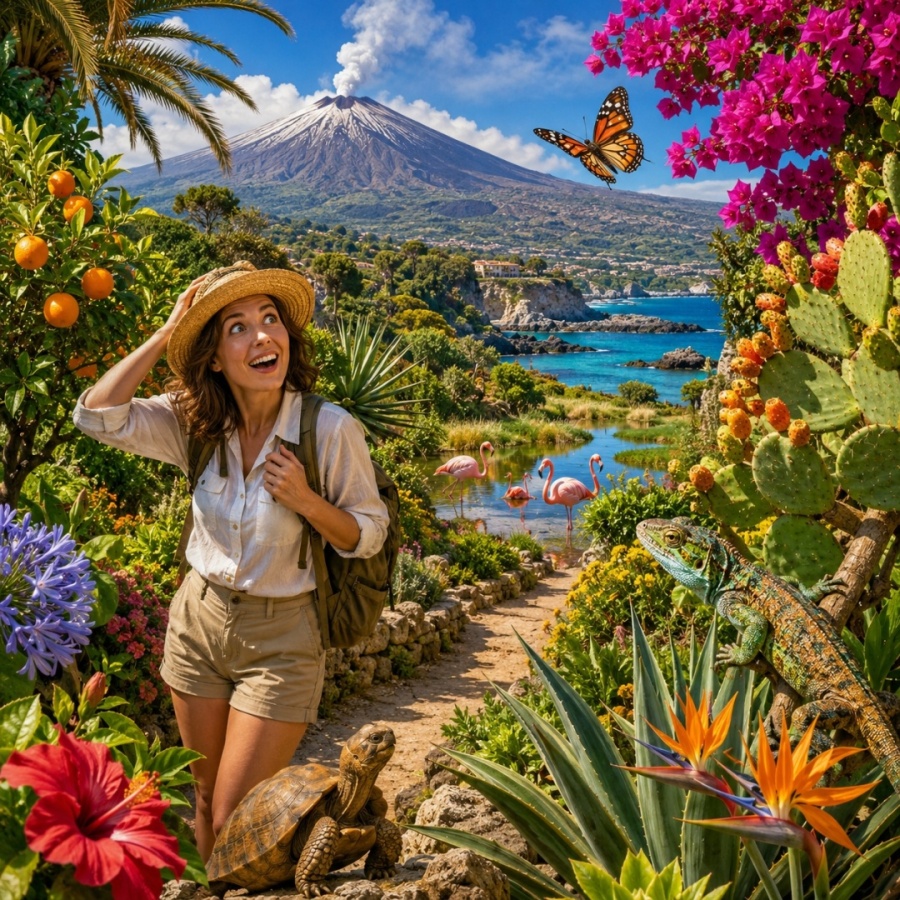
The Ultimate Guide to Sicily’s Botanical Gardens and Nature Reserves
The Ultimate Guide to Sicily’s Botanical Gardens and Nature Reserves
Sicily: Where Nature Has Clearly Been Showing Off
An island of gardens, forests, wetlands and volcanic drama
Sicily is often introduced with the usual suspects: beaches, ruins, food, villages, volcanoes and sunsets that behave as if they have hired a lighting designer.
All true. Very true.
But there is another Sicily that deserves just as much attention: the Sicily of botanical gardens, nature reserves, wild coastlines, mountain forests, wetlands, rare plants, volcanic ecosystems and landscapes where nature seems to be doing a full theatrical performance without asking anyone’s permission.
For travelers interested in Sicily botanical gardens, nature reserves in Sicily, Sicily biodiversity, Mount Etna nature tours and Mediterranean plants, the island offers an extraordinary variety of environments in a surprisingly compact space.
You can walk through subtropical gardens in Palermo, explore lava forests on Mount Etna, watch flamingos in coastal wetlands, hike through mountain parks and end the day beside the sea. Normal island behavior? Not really. Sicily simply enjoys overdelivering.
Why Sicily is a paradise for nature lovers
Sicily sits at the center of the Mediterranean, between Europe and Africa, shaped by volcanoes, mountains, sea currents, winds, human history and a climate that changes dramatically from coast to summit.
The result is a natural mosaic: citrus groves, lava fields, dunes, salt pans, wetlands, oak forests, beech woods, maquis shrubland, river gorges, coastal cliffs, marine reserves and botanical collections that tell stories from all over the world.
Sicily is not just beautiful. It is biologically, geologically and botanically complicated.
Which, frankly, suits it perfectly.
Orto Botanico di Palermo: A Historic Garden With Global Ambitions
The great botanical garden of Palermo
The Orto Botanico di Palermo is one of Sicily’s most important botanical gardens and one of the most fascinating green spaces in the city.
Founded in the late eighteenth century, it became a major scientific garden and a place where plants from different parts of the world were introduced, studied and cultivated.
Today, walking through the garden feels like stepping into a living encyclopedia, except warmer, greener and much more pleasant than most encyclopedias.
You can find monumental trees, tropical and subtropical species, palms, succulents, aquatic plants and collections that reflect Palermo’s long-standing relationship with science, climate and botanical curiosity.
Why visit?
Because the Orto Botanico is not just a garden. It is a historical document written in leaves, roots and shade.
It also offers a calm contrast to Palermo’s noisy energy. Outside, traffic, markets and city life move at full volume. Inside, huge trees quietly remind everyone that patience is an underrated strategy.
For travelers interested in plants, history and urban nature, the Palermo Botanical Garden is one of the best botanical stops in Sicily.
Villa Bellini and Catania’s Urban Green Side
A garden in the shadow of Mount Etna
Catania is famous for lava stone, Baroque architecture, street food and Mount Etna looming in the background like a dramatic relative who insists on being in every family photo.
But the city also has important green spaces, and Villa Bellini is among the most beloved.
This historic garden is not a wild nature reserve, of course. It is an urban park, carefully designed for strolling, shade, views and a little theatrical elegance. In Catania, even relaxing in a garden benefits from some architectural attitude.
Why it matters
Urban gardens like Villa Bellini show how Sicilian cities use greenery not only for beauty, but also for social life, shade and relief from the summer heat.
In a city built partly with dark volcanic stone, trees and gardens are not decorative extras. They are survival tools with style.
Villa Bellini is a pleasant stop for travelers exploring Catania, especially before or after heading toward Mount Etna, where the island’s urban green spaces give way to lava, forests and mountain ecosystems.
Mount Etna: Sicily’s Wildest Botanical Laboratory
Where lava becomes life
No guide to Sicily’s natural world would be complete without Mount Etna. The volcano is not only a geological icon; it is one of the island’s most fascinating ecological environments.
Etna’s landscapes change with altitude, exposure, lava age and volcanic activity. One moment you are walking through vineyards and orchards, then chestnut woods, pine forests, birch groves, lava fields and, higher up, bare volcanic desert.
It is basically a botanical staircase built by fire.
Which sounds extreme, because it is.
Pioneer plants and volcanic resilience
On fresh lava flows, the first life forms are often lichens, mosses and hardy pioneer plants. Slowly, over time, these help create the conditions for more complex vegetation.
What looks at first like a dead black landscape is often just nature preparing its comeback.
Etna teaches one of the most powerful lessons in Sicilian nature: destruction and fertility are not opposites here. They are part of the same story.
Very dramatic. Very Sicilian.
Etna birch, forests and endemic species
One of the most surprising sights on Etna is the presence of birch trees, especially at higher altitudes. Seeing birches on a Mediterranean volcano feels almost wrong, as if northern Europe took a wrong turn and decided to settle on lava.
The volcano also hosts pine woods, chestnut forests, broom, aromatic plants and species adapted to harsh conditions.
For nature lovers, hikers and anyone interested in volcanic ecosystems, Etna is one of Sicily’s most rewarding outdoor destinations.
Discover Mount Etna nature and hiking tours
Vendicari Nature Reserve: Wetlands, Beaches and Flamingos With Excellent Taste
A coastal reserve full of life
In southeastern Sicily, the Vendicari Nature Reserve is one of the island’s most beautiful protected areas.
It combines wetlands, sandy beaches, rocky coast, Mediterranean vegetation, old tuna-fishing structures and birdwatching opportunities, all in one landscape that seems to have been designed by someone with very good priorities.
Vendicari is especially important for migratory birds. Depending on the season, visitors may spot flamingos, herons, storks and many other species using the reserve as a resting place between Africa and Europe.
Even birds, apparently, know that Sicily is a good place for a stopover.
Nature, history and beaches together
One of the reasons Vendicari is so special is that it does not offer just one experience. You can walk along coastal trails, observe birds, swim in clear water, explore remains of old tuna-processing buildings and enjoy Mediterranean plants growing close to the sea.
It is a place where nature and human history meet without shouting at each other.
For travelers exploring Syracuse, Noto or southeastern Sicily, Vendicari is one of the best nature reserves to include in an itinerary.
Zingaro Nature Reserve: Sicily’s Coastal Wilderness
Cliffs, coves and Mediterranean maquis
The Zingaro Nature Reserve, between Scopello and San Vito Lo Capo, is one of Sicily’s most famous natural areas, and it deserves the attention.
This protected stretch of coast offers walking trails, cliffs, turquoise coves, dwarf palms, aromatic plants, wildflowers and some of the most photogenic coastal scenery on the island.
It is not subtle.
The Zingaro seems to understand that visitors enjoy dramatic sea views, and it provides them repeatedly, just in case anyone was not impressed the first twelve times.
Why visit?
Zingaro is ideal for travelers who want to combine hiking, swimming and Mediterranean vegetation in one day.
The reserve protects a beautiful example of coastal maquis, with plants adapted to sun, wind, salt and dry summers. In spring, the landscape can be especially colorful, while summer rewards early walkers with clear water and spectacular coves.
Bring good shoes, water and realistic expectations about the Sicilian sun, which has never been known for its modesty.
Madonie Regional Park: Sicily’s Mountain Garden
A greener, quieter Sicily
The Madonie Regional Park shows a completely different side of the island. Far from the usual beach image, the Madonie offer mountains, forests, small villages, wide views and a rich botanical heritage.
This is one of Sicily’s most important mountain areas for biodiversity.
Here you find oak woods, beech forests, rocky slopes, endemic plants and landscapes that feel surprisingly alpine for an island famous for summer heat and granita.
Sicily enjoys contradictions. It collects them, polishes them and then serves them with lunch.
Rare plants and mountain trails
The Madonie are known for their botanical importance, including rare and endemic species. The park is a wonderful destination for hikers, nature lovers and travelers interested in seeing a cooler, greener Sicily.
Spring and early summer are especially beautiful, with flowers, fresh vegetation and pleasant hiking conditions.
Villages such as Castelbuono, Petralia Soprana and other mountain towns also make the area rewarding for travelers who want nature, culture and local food in the same itinerary.
Why visit?
Because the Madonie remind visitors that Sicily is not only sea and volcanoes. It is also mountains, forests, silence, biodiversity and villages where time seems to have negotiated a slower contract.
Nebrodi Regional Park: Forests, Lakes and Wide Horizons
Sicily’s vast green north
The Nebrodi Regional Park is one of the largest protected natural areas in Sicily and an essential destination for travelers who want to discover the island’s greener side.
Located in northeastern Sicily, the Nebrodi are known for forests, pastures, lakes, mountain roads and wide landscapes that feel very different from the dry coastal image many visitors expect.
It is the kind of place that surprises travelers who thought Sicily was only beaches, temples and dramatic hand gestures.
Forests and rural landscapes
The Nebrodi are rich in woodland, including beech and oak forests, and support traditional rural activities, grazing lands and mountain villages.
This is a great area for slow travel, scenic drives, walking and discovering local products such as cheeses, meats and mountain cuisine.
Nature here feels generous, broad and less theatrical than Etna — although, being Sicily, it still keeps a few dramatic views available.
Why visit?
Because the Nebrodi show the island’s quiet strength. Less famous than some coastal reserves, they offer depth, space and a sense of rural authenticity that rewards travelers willing to leave the obvious route.
Alcantara Gorge: Where Water Cuts Through Lava
A natural sculpture near Mount Etna
The Alcantara Gorge is one of eastern Sicily’s most striking natural landscapes.
Here, the river has carved its way through ancient volcanic rock, creating dramatic basalt walls with geometric shapes that look almost designed.
Almost.
Nature, naturally, got there first and did not need a planning committee.
Plants, water and volcanic stone
The Alcantara area is not just about rock formations. It is also a river environment with vegetation, cool air and a refreshing contrast to the dry lava landscapes of Mount Etna.
For travelers exploring the Etna area, the gorge offers a beautiful example of how water and volcanic geology interact.
It is also a useful reminder that Sicily’s nature is not one thing. It is a conversation between fire, water, plants, stone and weather, usually all speaking at once.
Cavagrande del Cassibile: Canyons, Pools and Mediterranean Wilderness
A wild inland reserve in southeastern Sicily
Cavagrande del Cassibile is one of southeastern Sicily’s most impressive natural areas, known for its canyon landscapes, limestone cliffs, river pools and Mediterranean vegetation.
This is a place where Sicily becomes vertical, rocky and unexpectedly wild.
It is not the soft postcard version of the island. It is the version that says: yes, there is a beautiful natural pool down there, but perhaps earn it first.
Why it matters
Cavagrande shows the importance of inland ecosystems in Sicily. While beaches often get most of the attention, river valleys and gorges provide habitats for plants, animals and landscapes shaped by water over long periods.
The area is especially attractive for nature lovers, hikers and travelers interested in dramatic scenery away from the most common tourist routes.
As always in Sicily, good shoes, water and respect for the terrain are not optional decorations.
Saline di Trapani and Marsala: Where Salt, Wind and Birds Meet
Human history and natural habitat
The salt pans between Trapani and Marsala are among western Sicily’s most atmospheric landscapes.
Windmills, shallow salt basins, bright reflections, sea air and birdlife create a scene that feels both natural and human-made.
This is one of those Sicilian places where practical work accidentally became beautiful.
The salt pans are important for migratory birds and offer excellent opportunities for photography, slow walks and sunset watching.
Why visit?
Because this landscape shows how nature and traditional human activity can coexist when carefully managed.
It is also a wonderful addition to a western Sicily itinerary, especially when combined with Marsala, Trapani, Erice or a wine experience.
Salt, wine, windmills and flamingos. Sicily has never been shy about mixing themes.
Marine Reserves: Sicily’s Nature Continues Underwater
Protected seas and coastal biodiversity
Sicily’s natural heritage does not stop at the shoreline. Around the island, several marine reserves protect underwater habitats, rocky coasts, seagrass meadows and marine life.
Places such as Ustica, the Egadi Islands and Plemmirio near Syracuse are important for snorkeling, diving, coastal exploration and marine biodiversity.
For travelers who enjoy the sea, marine reserves offer a different way to experience Sicilian nature: not from a viewpoint, but with your face in the water, which is less elegant but very effective.
Why marine ecosystems matter
Posidonia seagrass meadows, rocky seabeds and protected coastal areas are essential for marine life. They support fish, invertebrates and ecological balance along the coast.
Choosing protected marine areas for snorkeling or diving can help visitors appreciate the richness of Sicily’s sea while supporting more responsible tourism.
How to Visit Sicily’s Gardens and Nature Reserves Responsibly
Respect trails, plants and wildlife
Sicily’s natural areas are beautiful, but many are fragile. Coastal dunes, wetlands, lava habitats and mountain ecosystems can be easily damaged by careless visitors.
Simple rules matter:
- Stay on marked trails
- Do not pick flowers or plants
- Do not disturb wildlife
- Carry enough water
- Avoid leaving waste
- Respect protected areas and seasonal restrictions
- Use local guides when exploring volcanic or remote areas
Nature has spent thousands of years creating these landscapes. Try not to undo the mood with a plastic bottle.
Choose the right season
Spring is ideal for flowers, green landscapes and pleasant temperatures. Autumn offers softer light, fewer crowds and good conditions for walking. Summer is beautiful but hot, so early starts are wise.
Winter can be surprisingly rewarding for quieter visits, especially in botanical gardens, wetlands, cities and lower-altitude reserves.
Sicily is not a one-season destination. It simply changes costume.
Final Thought: Sicily’s Wild Side Is Not a Side Attraction
Sicily’s botanical gardens and nature reserves are not minor extras between beaches and archaeological sites.
They are essential to understanding the island.
They reveal how Sicily breathes, grows, adapts and survives: through lava and salt, forest and sea, wetlands and mountains, ancient gardens and wild coastlines.
From the Orto Botanico of Palermo to the slopes of Mount Etna, from Vendicari’s flamingos to Zingaro’s coves, from Madonie forests to marine reserves, Sicily’s natural world is rich, surprising and wonderfully excessive.
Which is exactly how Sicily should be.
So bring walking shoes, curiosity, water and enough time to notice the details.
The island’s plants, birds, rocks, trees and coastlines have plenty to say.
And unlike Sicily’s drivers, they usually say it quietly.
🌿 Ready to explore Sicily’s botanical gardens, nature reserves and volcanic landscapes? Discover Mount Etna, wild trails, coastal reserves and authentic nature experiences with Etna Unlimited and experience the island’s greenest, wildest and most surprising side.