Sicily’s Archaeological Marvels: Top Historical Sites to Visit
Sicily’s Archaeological Marvels: Top Historical Sites to Visit
Sicily: Where Archaeology Refuses to Be Boring
An island built on layers of history
Sicily is not the kind of place where archaeology politely stays behind a museum rope. Here, ancient history is everywhere: on hilltops, beside beaches, under modern streets, next to cafés, and occasionally blocking your route because someone built a Greek theatre exactly where the view is best.
Which, to be fair, was excellent planning.
For travelers interested in Sicily archaeological sites, ancient ruins in Sicily, Greek temples in Sicily, Roman sites in Sicily and historical places to visit in Sicily, the island is almost unfairly rich.
Greek colonies, Roman villas, Phoenician cities, Byzantine traces, Arab influences, Norman architecture and Baroque rebirths all sit on top of each other like a very cultured lasagna.
Why Sicily is an archaeological paradise
Sicily’s position in the middle of the Mediterranean made it irresistible to almost everyone with a boat and territorial ambitions.
Greeks, Carthaginians, Romans, Byzantines, Arabs, Normans and Spaniards all passed through, settled, fought, built, rebuilt and left behind an extraordinary cultural landscape.
The result is an island where visiting historical sites does not feel like ticking boxes. It feels like walking through different chapters of Mediterranean history, often with a better sea view than strictly necessary.
Valley of the Temples, Agrigento
The superstar of Sicily’s Greek ruins
If Sicily’s archaeological sites had a red carpet, the Valley of the Temples in Agrigento would arrive late, look magnificent and pretend it was not trying to impress anyone.
This is one of the most famous Greek archaeological sites in Sicily, and for good reason. The monumental Doric temples rise along a ridge overlooking the countryside and the sea, creating one of the most iconic landscapes in the Mediterranean.
Despite its name, the Valley of the Temples is not really in a valley. It is more of a ridge. But after more than two thousand years, it feels a little rude to correct it.
What to see
The most famous monument is the Temple of Concordia, one of the best-preserved Greek temples in the world. It stands with such calm confidence that even people who claim they are “not really into ruins” usually become suspiciously quiet in front of it.
Other highlights include the Temple of Juno, the Temple of Heracles, the Temple of Olympian Zeus and the surrounding archaeological landscape.
What makes Agrigento special is not only the temples themselves, but the sense of scale. You do not just see ancient architecture. You feel the ambition of a powerful Greek city that clearly had no interest in being modest.
Why visit?
Because it is one of the essential historical sites in Sicily. Because the sunset is spectacular. Because the temples are extraordinary. And because sometimes ancient stones really do deserve the hype.
Syracuse Archaeological Park and Ortigia
Ancient Greece with sea air and excellent drama
Syracuse was once one of the most powerful cities of the ancient Greek world. Not “important for Sicily.” Important for the entire Mediterranean.
At its height, Syracuse rivaled Athens in wealth, influence and cultural importance. Which is the kind of historical flex most cities can only dream of.
Today, the Archaeological Park of Neapolis and the island of Ortigia make Syracuse one of the best places to visit for anyone interested in Greek history in Sicily and ancient urban life.
The Greek Theatre of Syracuse
The Greek Theatre of Syracuse is one of the greatest ancient theatres in the Mediterranean. Carved into the rock, it could host thousands of spectators for tragedies, comedies and civic events.
Imagine sitting there in antiquity, watching a dramatic performance while politics, philosophy, gossip and public opinion moved through the crowd.
Basically, social media with better acoustics and fewer anonymous accounts.
The Ear of Dionysius and Roman Amphitheatre
The nearby limestone quarry known as the Ear of Dionysius adds a touch of legend to the visit. Its unusual shape and powerful echo gave rise to stories involving tyrants, prisoners and suspiciously convenient acoustics.
The Roman Amphitheatre shows another layer of Syracuse’s past, reminding visitors that Rome also arrived, made things bigger and added its own entertainment preferences, some of which were not exactly gentle family fun.
Ortigia: where history becomes atmosphere
Ortigia, the historic heart of Syracuse, is not just beautiful. It is a living archaeological puzzle. Greek temples became churches, ancient stones became part of later buildings, and narrow streets carry layers of memory.
Here, archaeology is not isolated from the city. It is the city.
Ancient Theatre of Taormina
The view that stole the show
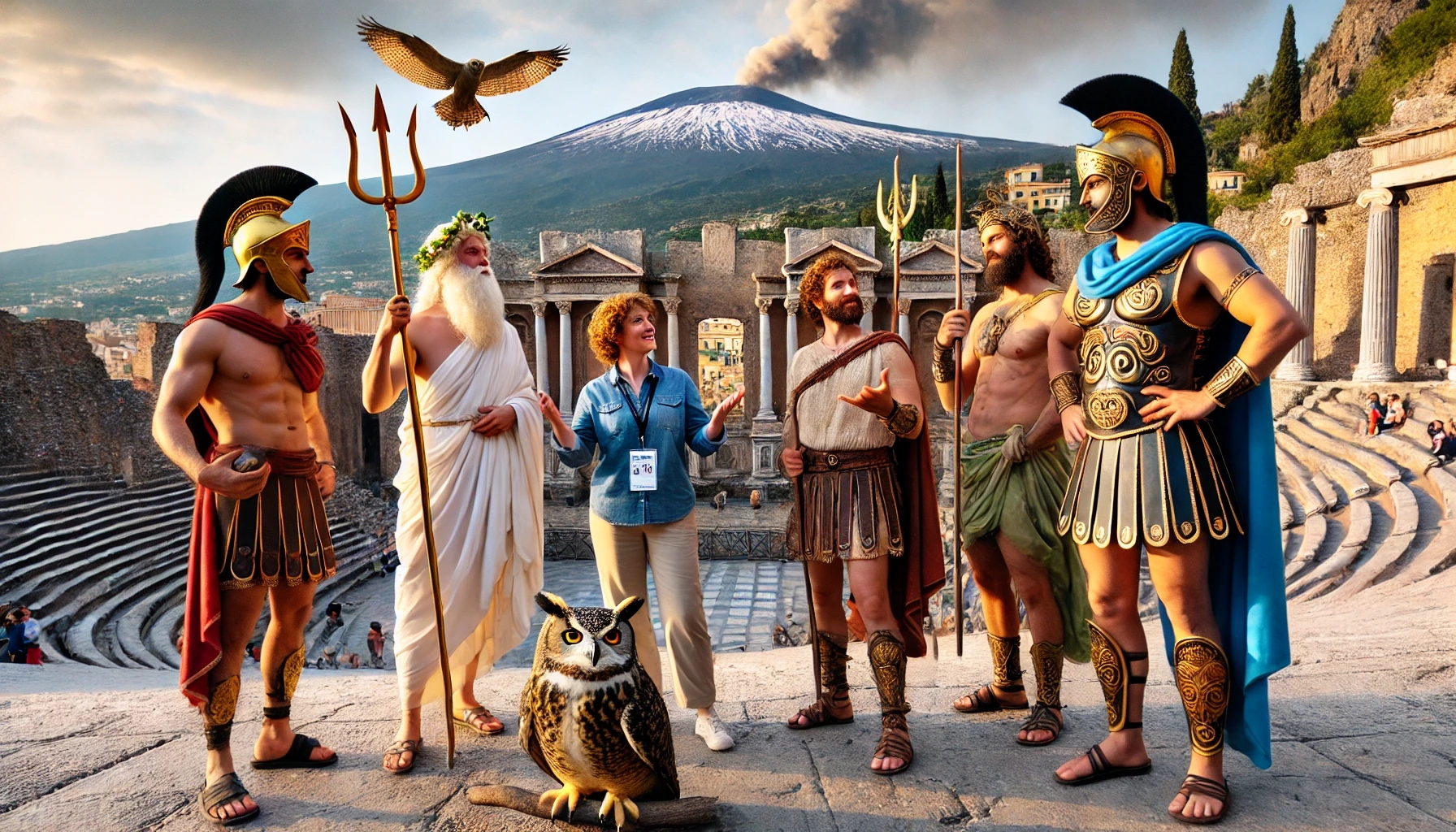
The Ancient Theatre of Taormina is one of Sicily’s most famous historical sites, and it has a slight problem: the view is so spectacular that it almost distracts from the archaeology.
Ancient stone seats, the Ionian Sea, the coastline and Mount Etna in the background, honestly, subtlety was never the goal.
The theatre has Greek origins and was later enlarged and modified by the Romans, because Rome rarely encountered something impressive without thinking, “Yes, but bigger.”
Why it matters
This site is one of the best examples of how Sicily’s history is layered. Greek foundation, Roman transformation, modern performances, and thousands of visitors trying to take the same photo without strangers in it.
Good luck with that.
The theatre also shows how ancient builders understood landscape. They did not just build a performance space. They framed nature itself.
Why visit?
Because it combines archaeology, scenery and atmosphere better than almost anywhere else in Sicily. It is a historical site, a theatre, a viewpoint and a reminder that the ancients knew exactly where to place premium seating.
Selinunte Archaeological Park
Huge, wild and slightly overwhelming
Selinunte is one of the largest archaeological parks in Europe and one of the most impressive ancient Greek sites in Sicily.
Unlike some polished historical attractions, Selinunte feels vast, open and a little wild. Temples, ruins, columns and ancient urban areas stretch across the landscape near the sea.
It is the kind of place where you start with a peaceful walk and suddenly realize you are casually crossing the remains of a once-powerful Greek city.
As one does.
A city of temples and ruins
Selinunte was founded by Greek colonists and became an important city before being destroyed in conflicts with Carthage. Today, its ruins tell a story of ambition, power, destruction and archaeological beauty.
The temples are massive, some standing, others collapsed in dramatic piles of stone that look as if giants left after a very bad argument.
The scale of the site is what makes Selinunte unforgettable. It feels less like visiting a monument and more like walking through the skeleton of an ancient city.
Why visit?
Because Selinunte offers space, drama and a sense of discovery. It is ideal for travelers who want ancient ruins without feeling trapped in a narrow tourist corridor.
Bring comfortable shoes. Ancient cities were not designed for people trying to “just have a quick look.”
Segesta: Temple and Theatre in the Hills
A mysterious temple with excellent posture
Segesta is one of Sicily’s most atmospheric archaeological sites. Its unfinished Doric temple stands alone in the countryside, surrounded by hills and silence.
There is something mysterious about it. No crowded ancient city around it, no overwhelming urban ruins, just a majestic temple standing in the landscape as if it knows something you do not.
Which is very on brand for ancient ruins.
The theatre above the landscape
Higher up, the ancient theatre of Segesta offers sweeping views over hills, valleys and distant mountains. It is smaller than the theatres of Syracuse or Taormina, but its setting is extraordinary.
The walk or shuttle up to the theatre is worth it. Once there, you understand again how ancient builders had an irritatingly good eye for location.
Why visit?
Because Segesta is elegant, scenic and slightly enigmatic. It is one of the best historical places in western Sicily and a perfect stop between Palermo, Trapani and the inland countryside.
Villa Romana del Casale, Piazza Armerina
Roman luxury with mosaic floors that refuse to be ignored
The Villa Romana del Casale is one of the most important Roman sites in Sicily, famous for its astonishing mosaics.
This was not a humble countryside house. It was a luxurious Roman villa decorated with scenes of hunting, mythology, animals, athletes and daily life.
The mosaics are so detailed and vivid that they sometimes feel less like floors and more like a Roman documentary series created in stone.
Why the mosaics matter
The mosaics at Villa Romana del Casale offer a rare glimpse into Roman aristocratic life. They show not only wealth, but imagination, taste, power and a clear desire to impress guests before they even reached the dining room.
Ancient interior design, apparently, was not afraid of commitment.
The famous scenes of athletes are among the most recognizable images from the villa, but the entire site is worth exploring carefully.
Why visit?
Because it is one of the finest examples of Roman mosaic art in the Mediterranean. And because it proves that even in antiquity, people knew the value of making their home look slightly better than everyone else’s.
Morgantina and Aidone
The quieter archaeological treasure
Morgantina, near Aidone in central Sicily, is one of the island’s most interesting but less crowded archaeological sites.
This ancient city offers a different kind of experience. Instead of monumental temples designed to dominate the landscape, Morgantina reveals streets, houses, public spaces, a theatre and traces of daily life.
It feels intimate, human and surprisingly easy to imagine.
A city where daily life comes into focus
Morgantina helps visitors understand ancient Sicily beyond temples and grand monuments. Here, you can picture markets, conversations, work, politics, domestic life and the ordinary routines that made a city function.
Not every ancient person spent the day building temples or discussing philosophy in a dramatic cloak. Someone had to buy bread.
The Archaeological Museum of Aidone
The nearby museum in Aidone adds important context, with finds from Morgantina and the surrounding area.
Combining the site and the museum makes the visit especially rewarding for travelers who enjoy archaeology with depth and fewer crowds.
Tindari: Greek Theatre, Sanctuary and Sea Views
A historical site with a dramatic balcony
Tindari, on Sicily’s northern coast, combines archaeology, spirituality and spectacular views over the Tyrrhenian Sea.
The ancient city was founded by Greek settlers and later developed under Roman rule. Today, visitors can explore its archaeological area, including the theatre, ancient streets and Roman remains.
The setting is part of the magic. The site overlooks the coast and the famous sand formations of Marinello below.
Ancient stones and sacred stories
Tindari is also known for its sanctuary, creating a fascinating mix of ancient history and religious tradition.
It is one of those Sicilian places where mythology, archaeology, faith and landscape all appear to have agreed to meet in the same location.
Very convenient for visitors. Very typical of Sicily.
Why visit?
Because Tindari offers a rich combination of historical ruins, sea views and cultural atmosphere. It is especially interesting for travelers exploring northern Sicily between Messina, Milazzo and the Aeolian Islands.
Catania: Roman Ruins Under a Baroque City
History beneath the lava stone
Catania is often associated with Baroque architecture, street food, lava stone and Mount Etna. But beneath the city’s lively surface lies a deep Roman past.
The Roman Theatre, Odeon, amphitheatre remains and underground traces reveal an ancient city layered beneath later destruction, rebuilding and volcanic drama.
Catania has been damaged by eruptions, earthquakes and history in general. Its response has usually been: rebuild, decorate, continue eating well.
The Roman Theatre of Catania
The Roman Theatre is one of the most fascinating archaeological sites in the city. Hidden within the urban fabric, it feels like a secret historical pocket surrounded by modern life.
This is part of Catania’s charm. You can move from a busy street to ancient ruins in a few steps, which is very Sicilian and slightly confusing in the best way.
Why visit?
Because Catania shows archaeology in layers, not isolation. Ancient, medieval, Baroque and modern elements coexist in a city that refuses to be simple.
And honestly, simple would not suit Catania.
Solunto: A Hilltop City Overlooking the Sea
The underrated ancient city near Palermo
Solunto, near Palermo, is one of those archaeological sites that deserves more attention than it usually gets.
Set on a hillside above the sea, the ancient city offers remains of streets, houses, public buildings and panoramic views over the coast.
It is quieter than the major famous sites, which means you can actually hear the wind, your footsteps and possibly your own thoughts. Dangerous, but interesting.
Why Solunto is special
Solunto has Phoenician and Hellenistic roots and offers a valuable perspective on western Sicily’s ancient history. The urban layout is easy to read, making it especially rewarding for visitors who enjoy imagining how ancient cities functioned.
Its location is spectacular, proving once again that ancient communities had excellent real estate instincts.
Why visit?
Because Solunto is scenic, quieter and ideal for travelers staying near Palermo who want archaeology without the crowds of the most famous sites.
How to Plan an Archaeological Trip in Sicily
Do not try to see everything in two days
Sicily’s historical sites are spread across the island, and trying to visit them all in one short trip is a noble but slightly unrealistic idea.
The island is larger than many visitors expect. Distances take time, roads have opinions, and archaeological parks are not designed to be consumed like snacks.
Choose an area and explore it properly.
Suggested routes
- Eastern Sicily: Syracuse, Taormina, Catania, Mount Etna
- Southern Sicily: Agrigento, Villa Romana del Casale, Morgantina
- Western Sicily: Segesta, Selinunte, Solunto, Palermo
- Northern Sicily: Tindari, Cefalù, Milazzo, Aeolian connections
Travel with context
Ancient ruins become far more powerful when you understand the stories behind them. A column is beautiful. A column connected to trade, war, gods, politics and earthquakes becomes unforgettable.
This is where a good local guide can make a huge difference. Not because visitors cannot see old stones by themselves, but because without context, even the most important ruins risk becoming “nice rocks with sunshine.”
And Sicily deserves better than that.
Final Thought: Sicily’s Past Is Not Past
Sicily’s archaeological marvels are not just remains of disappeared civilizations. They are part of the island’s living identity.
Temples, theatres, mosaics, ancient streets and ruins still shape the way Sicily looks, speaks and welcomes travelers.
The past here is not silent. It is layered, sunlit, theatrical and occasionally dramatic enough to deserve its own soundtrack.
From Agrigento to Syracuse, from Taormina to Selinunte, from Roman villas to hidden hilltop cities, Sicily invites travelers to experience history not as a school subject, but as a landscape.
One with temples, sea views, volcanoes, mosaics and, inevitably, excellent food nearby.
Because this is Sicily. Even archaeology knows when it is time for lunch.
🏛️ Ready to explore Sicily’s archaeological wonders beyond the usual postcard view? Discover ancient theatres, Greek temples, Roman ruins and timeless landscapes with Etna Unlimited and experience the island’s history where it still feels alive.