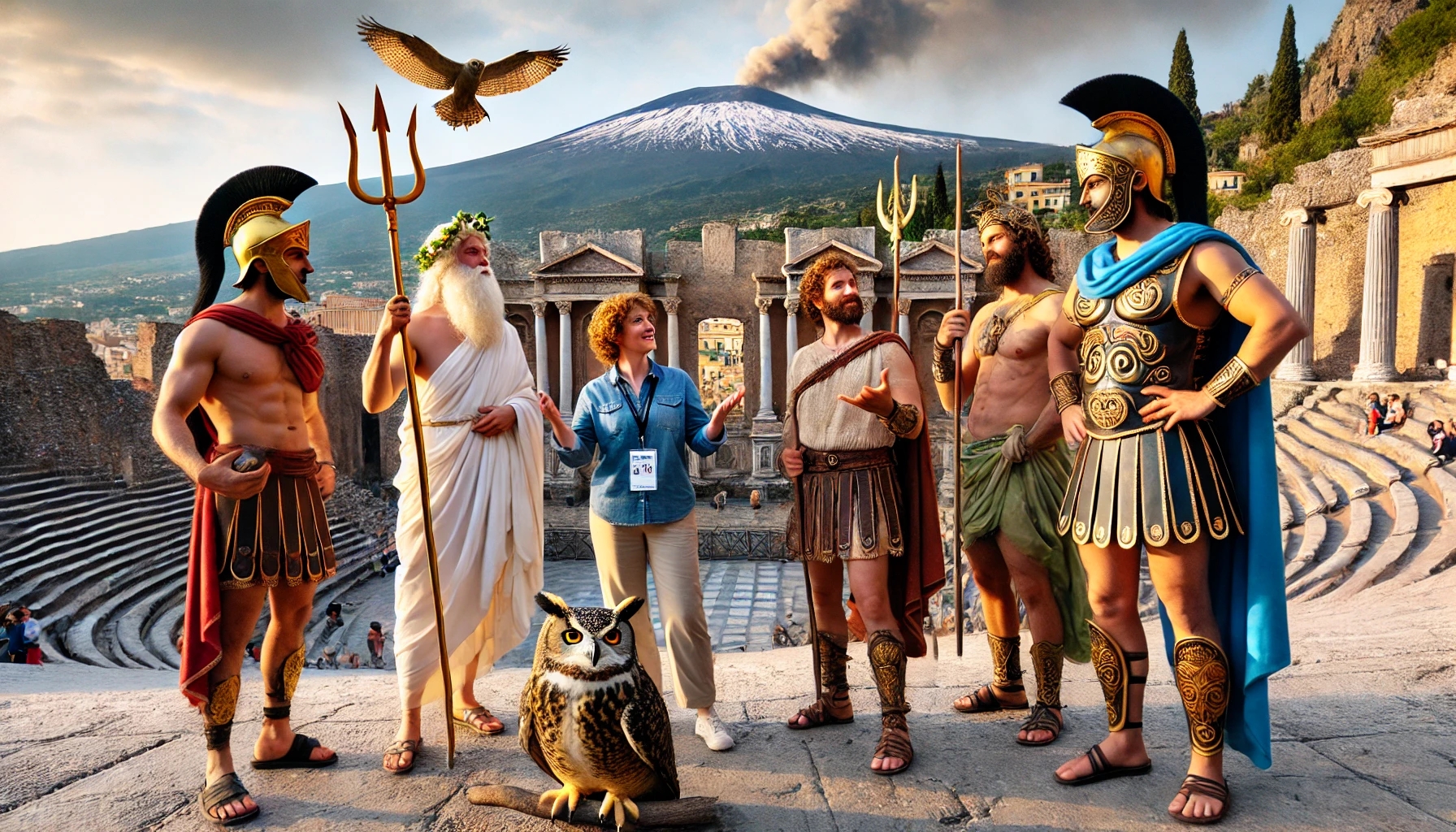
Unraveling Sicily’s Past: A Journey Through Ancient Ruins and Legends
Unraveling Sicily’s Past: Ancient Ruins, Legends and Timeless Stories
Sicily: Where History Refuses to Stay Quiet
A Mediterranean island with too many former landlords
Sicily is not the kind of place where history politely stays inside museums. It spills into the streets, hides under churches, climbs onto hilltops and occasionally sits beside your lunch like an elderly relative with excellent stories and no intention of leaving.
Greek temples, Roman theatres, Arab courtyards, Norman castles, Baroque towns, lava-stone villages, the island has been shaped by so many civilizations that calling Sicily “historic” feels almost lazy.
This is a place where a casual walk can become an accidental archaeology lesson. Turn a corner and there is a medieval gate. Look down and the paving stones may be older than several modern nations. Look up and Mount Etna is smoking quietly, because apparently the landscape also enjoys theatrical timing.
Why ancient Sicily still matters
For travelers interested in Sicily ancient ruins, Greek temples in Sicily, Roman history and Mount Etna legends, the island offers something rare: history you can actually feel.
Not distant. Not dusty. Not locked behind glass.
Here, the past is part of daily life. People shop near ancient walls, drink coffee beside old churches and drive past ruins that would be the main attraction almost anywhere else. In Sicily, they are simply part of the scenery. Naturally, the scenery is showing off.
The Greeks in Sicily: Temples, Myths and Very Ambitious Architecture
When Sicily became Magna Graecia
Long before Italy became Italy, Sicily was one of the great centers of the Greek world. From the 8th century BC onward, Greek colonists founded powerful cities such as Syracuse, Naxos, Selinunte and Akragas, today’s Agrigento.
They brought language, theatre, philosophy, urban planning and a clear belief that if you were going to build a temple, you might as well make it visible from another time zone.
The legacy is extraordinary. Sicily preserves some of the most impressive Greek archaeological sites in the Mediterranean, including the Valley of the Temples, the theatre of Syracuse and the ruins of Selinunte.
The Valley of the Temples: dramatic ruins with excellent posture
The Valley of the Temples in Agrigento is one of Sicily’s great archaeological wonders. Despite the name, it is not actually in a valley. Minor detail. Ancient naming departments were clearly busy with bigger problems.
Here, massive Doric temples rise from a ridge overlooking the countryside and the sea. The Temple of Concordia, remarkably preserved, looks as if it has spent the last two thousand years waiting for visitors to finally appreciate its good side.
Walking among these ruins is not just about architecture. It is about scale. Power. Belief. The idea that stone could speak on behalf of gods, cities and human ambition.
Syracuse: where theatre met politics, poetry and chaos
Syracuse was one of the most important Greek cities in the ancient world. At its height, it rivaled Athens in wealth and influence. Today, it remains one of the best places in Sicily to understand how deeply Greek culture shaped the island.
The Greek Theatre of Syracuse is carved into the hillside and still carries an astonishing sense of presence. Imagine thousands of spectators gathered for tragedies, comedies and political messages disguised as entertainment.
So, basically, ancient social media, but with better acoustics and fewer comment sections.
Roman Sicily: Villas, Roads and Imperial Practicality
From Greek brilliance to Roman organization
When Rome took control of Sicily, the island became one of the empire’s most important provinces. Sicily supplied grain, strategic ports and valuable resources. Rome looked at the island and thought: “Excellent. Beautiful, useful and already full of infrastructure.”
The Romans were practical. They expanded roads, cities, theatres, villas and agricultural systems. Where the Greeks had worshipped beauty and proportion, the Romans added administration, engineering and taxes. Naturally.
Villa Romana del Casale: mosaics with personality
One of the most spectacular Roman sites in Sicily is the Villa Romana del Casale, near Piazza Armerina. Famous for its astonishing mosaics, the villa offers a vivid glimpse into aristocratic Roman life.
The floors show hunting scenes, mythological figures, animals, athletes and daily life. They are detailed, colorful and strangely alive. Some rooms feel less like ruins and more like a Roman Instagram feed created entirely in stone.
For travelers exploring Roman ruins in Sicily, this site is essential.
Taormina: Greek origins, Roman upgrades, eternal views
The ancient theatre of Taormina is often called Greek, and it is. But the Romans later modified it, because Rome rarely saw a good thing without thinking: “We can make this bigger.”
Today the theatre offers one of the most iconic views in Sicily: ancient stone seats, the blue Ionian Sea and Mount Etna rising in the distance.
It is almost unfairly beautiful. The kind of view that makes cameras nervous.
Mount Etna: The Volcano That Became a Myth Machine
Gods, giants and underground drama
No journey through Sicily’s past is complete without Mount Etna. The volcano is not just a natural landmark. It is one of the great mythological engines of the Mediterranean.
For ancient Greeks and Romans, Etna was a place of fire, mystery and divine activity. Myths placed the forge of Hephaestus beneath the volcano. Other stories imagined giants trapped under the mountain, shaking the earth when they moved.
To be fair, when a mountain erupts lava, throws ash into the sky and occasionally growls at night, “angry giant underground” is not the worst first theory.
Etna in ancient literature
Etna appears in the writings of poets, philosophers and historians. Ancient authors tried to explain its eruptions using the knowledge available to them: underground winds, fiery caverns, sea water, divine forces and occasionally a generous amount of imagination.
Today, modern volcanology explains Etna through magma, tectonics, gases and volcanic conduits. But the emotional truth remains the same: Etna has always inspired awe.
It frightened soldiers, fascinated philosophers and shaped the landscape of eastern Sicily. It still does.
Exploring Etna today
Visiting Etna today means walking through layers of natural and human history. Lava fields, craters, forests and old eruption sites tell stories as clearly as any temple wall.
A guided Etna tour is not only a nature experience. It is a journey through geology, mythology and Sicilian identity — with better shoes and fewer sacrifices to the gods.
Discover Mount Etna trails and volcanic landscapes
Arabs, Normans and the Beautiful Confusion of Sicilian Identity
The Arab influence: water, gardens and cleverness
After the classical age, Sicily continued collecting civilizations with impressive enthusiasm. The Arab period brought new agricultural techniques, irrigation systems, citrus fruits, spices, urban development and scientific knowledge.
Many Sicilian landscapes still carry this legacy. Terraced fields, citrus groves, place names, food traditions and architectural details all whisper of that period.
Without Arab influence, Sicilian cuisine would be much less exciting. And that, frankly, would be a tragedy of international importance.
The Normans: northern warriors who went full Mediterranean
Then came the Normans. Originally from northern Europe, they arrived in Sicily and somehow created one of the most fascinating multicultural kingdoms of the Middle Ages.
Norman Sicily blended Latin, Greek, Arab and Byzantine elements into architecture, art and administration. Palermo became a dazzling capital where cultures did not simply coexist, they decorated the ceiling together.
The Norman Palace and Palatine Chapel in Palermo remain extraordinary examples of this fusion. Golden mosaics, Islamic-inspired patterns, Latin power and Byzantine brilliance all share the same space without asking for permission.
Sicily’s talent for absorbing everything
Sicily did not erase its past. It layered it.
Greek foundations, Roman structures, Arab gardens, Norman churches, Spanish balconies, Baroque facades, the island became a cultural palimpsest. A very beautiful one. Occasionally chaotic, but always interesting.
Baroque Towns and Earthquake Drama
The 1693 earthquake and a new architectural language
In 1693, a devastating earthquake struck southeastern Sicily. Cities were destroyed, communities were shaken and the landscape of the Val di Noto changed forever.
The rebuilding that followed produced one of Sicily’s most extraordinary artistic chapters: Sicilian Baroque.
Towns such as Noto, Ragusa, Modica, Scicli and Catania rose again with theatrical facades, grand staircases, ornate balconies and churches that seem to say, “We suffered, yes, but we will recover with style.”
Catania: lava stone and resilience
Catania is one of the best examples of a city shaped by both earthquake and volcano. Built with black lava stone and pale limestone, it has a dramatic visual identity unlike anywhere else in Sicily.
Its streets tell a story of destruction and rebirth. Earthquakes, eruptions and human stubbornness all contributed to the city’s character.
Catania does not hide its scars. It turns them into architecture.
Legends in the streets
In Sicily, even city symbols have stories. Catania’s elephant fountain, local saints, underground rivers, lava caves and old city gates all carry layers of legend and memory.
Some stories are historical. Some are symbolic. Some may have improved significantly after several glasses of wine.
All are part of the island’s charm.
How to Explore Sicily’s Ancient Ruins Without Turning It Into Homework
Choose fewer places and go deeper
Sicily is rich in ruins, but trying to see everything in one trip is a common mistake. The island rewards depth more than speed.
Instead of racing between archaeological sites like a panicked historian with a rental car, choose a few meaningful places and allow time to understand them.
- For Greek history: Agrigento, Syracuse, Selinunte, Taormina
- For Roman heritage: Villa Romana del Casale, Catania, Taormina
- For myths and volcanoes: Mount Etna and eastern Sicily
- For medieval culture: Palermo, Cefalù, Monreale
- For Baroque beauty: Noto, Ragusa, Modica, Scicli, Catania
Travel with context
Ancient stones are more interesting when someone explains why they matter. A temple is beautiful. A temple connected to politics, gods, trade, earthquakes and local legends is unforgettable.
This is where a good guide changes everything. Not because you need someone to point at old stones and say “old stones,” but because stories give ruins their pulse.
Mix culture with nature and food
The best Sicily itinerary combines ancient sites, landscapes and local flavors. Visit a Greek theatre in the morning, explore lava terrain in the afternoon, and end the day with Etna wine or pasta alla Norma.
This is not indulgence. This is cultural research with sauce.
Final Thought: Sicily Is Not a Museum. It Is a Living Archive.
Sicily’s past is not locked away in archaeological parks. It lives in town names, recipes, stones, festivals, myths, landscapes and the way people speak about places as if they were old relatives.
The island does not offer one history. It offers many.
Greek, Roman, Arab, Norman, Spanish, volcanic, rural, sacred, chaotic, delicious.
And somehow, it all works.
Exploring Sicily’s ancient ruins and legends means understanding that the island was never just conquered. It transformed everything it received.
That is Sicily’s genius.
🏛️ Ready to explore Sicily beyond the postcards? Discover ancient ruins, volcanic landscapes and timeless legends with Etna Unlimited and experience the island through stories that still feel alive.