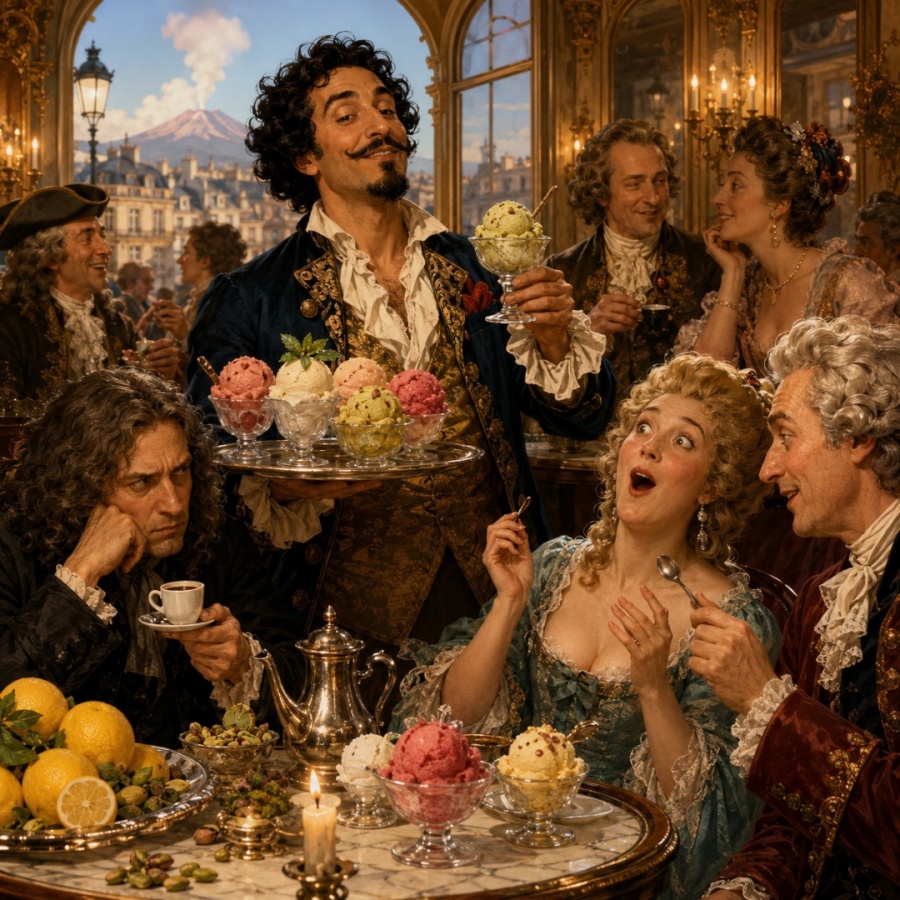
Francesco Procopio dei Coltelli: The Sicilian Father of Gelato in Paris
Francesco Procopio dei Coltelli: The Sicilian Who Took Gelato to Paris
Long before gelato became something tourists photograph from five different angles before letting it melt all over their fingers, there was Francesco Procopio dei Coltelli.
Sicilian, entrepreneur, café pioneer, frozen-dessert legend and depending on how generous one wants to be with historical titles, one of the great fathers of modern gelato.
His story begins in Sicily and explodes, politely, with porcelain cups and cold desserts in Paris, where in the late seventeenth century he helped transform the simple act of drinking coffee and eating something sweet into a social, literary and intellectual ritual.
In other words, before Paris became one of the great capitals of elegant café culture, a Sicilian arrived and said, more or less: “Nice city. Needs better refreshments.”
A Sicilian Story, Naturally With Some Confusion
Palermo, Aci Trezza, or both?
Francesco Procopio dei Coltelli is usually remembered as a Sicilian chef and entrepreneur born in the seventeenth century. His exact birthplace, however, is still debated. Some traditions connect him with Aci Trezza, the fishing village near Catania and Mount Etna. Other sources point toward Palermo, where documentary evidence has strengthened the case for a Palermo origin.
So, as often happens in Sicilian history, the island gives us a brilliant figure and then politely refuses to make the paperwork simple.
What matters is that Procopio came from Sicily, an island where ice, snow, sugar, citrus, almonds, spices and Arab-influenced sorbet traditions had already created a serious relationship with cold sweets.
And by “serious relationship,” we mean the kind of relationship Sicilians have with food: emotional, technical, territorial and slightly unwilling to accept criticism.
The Etna snow connection
Sicily had long traditions linked to snow and ice preservation, especially in mountain areas. On Mount Etna, snow was collected and stored in snow houses, then used during warmer months to prepare chilled drinks and frozen desserts.
This does not mean Procopio personally walked up Etna with a shovel and a business plan under his arm. History is rarely that cinematic, unfortunately.
But it does mean that Sicily offered the cultural and practical background for frozen preparations long before gelato became a fashionable European pleasure.
Procopio did not come from nowhere. He came from an island that already knew how to make heat slightly less unbearable.
From Sicily to Paris: A Very Cold Sicilian Revolution
A young entrepreneur in France
In the second half of the seventeenth century, Procopio moved to France, eventually settling in Paris. This was a smart move. Paris was wealthy, fashionable, intellectually restless and increasingly interested in exotic drinks like coffee.
It was also, by modern standards, badly in need of good cafés.
Procopio understood something essential: food and drink are never just food and drink. They are setting, service, atmosphere, presentation and social theatre.
In Sicily, you may have the product. In Paris, you need the stage.
The power of presentation
Procopio’s genius was not simply that he served cold desserts. Frozen sweets already had a long history in Mediterranean cultures. His real talent was turning them into an elegant public experience.
Instead of treating coffee, sorbets and iced desserts as curiosities, he offered them in a refined environment where people could sit, talk, observe, read, argue and pretend their opinions were necessary for the future of civilization.
Which, in Paris, is basically the beginning of café culture doing what café culture does best: turning beverages into conversation, conversation into debate, and debate into everyone staying much longer than planned.
Le Procope: The Café That Changed Everything
Opening around 1686
In c. 1686, Francesco Procopio dei Coltelli opened what became the legendary Café Procope, also known as Le Procope, in Paris.
Located in the Saint-Germain-des-Prés area, close to the world of theatres, writers and intellectual life, the café quickly became one of the most famous meeting places in the city.
The location helped. The atmosphere helped. The coffee helped. The frozen desserts definitely helped.
And let us be honest: if you give writers coffee, sugar and a room where they can feel important, history will eventually happen.
Not just a café, but a stage for ideas
Le Procope became associated with the literary and intellectual life of Paris. Over time, it was linked to names such as Voltaire, Rousseau, Diderot and other figures of the Enlightenment and French cultural history.
This is where the story becomes almost absurdly glamorous. A Sicilian entrepreneur opens a café in Paris, serves coffee and frozen sweets, and the place becomes part of the intellectual mythology of Europe.
That is quite a career move.
Most people open a business hoping to pay rent. Procopio accidentally helped create a salon for philosophers who would spend decades explaining reason, liberty, society and probably why the bill should be split in a more rational way.
It is important to note the chronology: Voltaire, Diderot and Rousseau belonged to the later fame of Le Procope, not to the exact moment of Procopio’s opening. But that makes the story even more interesting. Procopio created the stage; later generations of Parisian thinkers walked onto it and behaved exactly as dramatically as expected.
Did Francesco Procopio Invent Gelato?
The useful answer: not exactly, but he made it famous
Now we come to the dangerous question: did Francesco Procopio dei Coltelli invent gelato?
The honest answer is: not in the simple cartoon version of history.
Frozen desserts existed before him. Sorbets, snow-cooled drinks and iced preparations had circulated in Mediterranean and Arab-influenced food cultures for centuries. Renaissance courts also played an important role in the development of frozen desserts in Italy.
So no, Procopio did not wake up one morning, look at a lemon, point at a block of ice and single-handedly invent happiness.
History, annoyingly, is more complex than marketing.
What Procopio actually did
What Procopio did was perhaps even more important: he helped make frozen desserts commercially successful and socially fashionable in Paris.
He improved techniques, developed production and presentation, and brought Sicilian and Italian frozen sweets into the elegant world of Parisian cafés.
He turned a cold dessert into something people could buy, enjoy publicly and associate with refinement.
That may not be “invention” in the mythological sense, but it is cultural transformation.
And cultural transformation served in a small cup is still cultural transformation.
Coffee, Sorbet and the Birth of Café Culture
Paris discovers the café
In seventeenth-century Europe, coffee was still relatively new, exotic and fashionable. It came with a sense of novelty and sophistication, which is always useful when trying to convince people to pay money for a bitter dark drink that keeps them awake and makes them talk too much.
Procopio understood the moment perfectly.
Le Procope offered coffee in an elegant setting, along with cold drinks, sorbets, liqueurs and frozen desserts. It was not just a place to consume. It was a place to spend time.
And once people have a place to spend time, they start talking. Once they start talking, they start arguing. Once they start arguing, someone eventually writes a book, a manifesto or a very intense letter.
This is how civilization progresses, apparently.
The café as social technology
Today we think of cafés as normal. A table, a drink, a conversation, someone writing dramatically in a notebook. Nothing surprising.
But in Procopio’s time, the café was a new kind of social space. It was neither private home nor tavern, neither court nor marketplace. It was a place where social classes, ideas, literature, politics and fashion could meet over coffee and sweets.
In this sense, Le Procope was not only a food business. It was social technology.
Very elegant technology, naturally. With better chairs than most revolutions deserve.
The Sicilian Genius of Turning Necessity Into Pleasure
From heat to refreshment
There is something deeply Sicilian in Procopio’s success. Sicily is an island of intense summers, strong flavours and practical intelligence. If the sun is brutal, you do not simply complain. Well, you complain, obviously. But then you invent granita, sorbet, ice storage, lemon drinks and eventually a way to make everyone else pay for them.
That is not just gastronomy. That is survival with elegance.
Procopio carried this logic into Paris. He transformed cold sweetness into luxury, refreshment into fashion and Sicilian know-how into a European cultural phenomenon.
The island behind the cup
Behind Procopio’s story, we can glimpse Sicily’s wider food history: citrus, almonds, sugar, spices, snow, sea routes, Arab influences, Spanish connections and a long talent for absorbing cultures and turning them into something edible.
Sicily has always been a culinary crossroads. Procopio was one of the people who carried that crossroads abroad.
He did not simply bring a recipe. He brought an island’s instinct for pleasure.
And Paris, to its credit, did not resist very hard.
Le Procope and the Enlightenment: When Dessert Met Philosophy
A café full of dangerous thinkers
Le Procope became famous as a meeting place for writers, artists and political thinkers. It is associated with the French Enlightenment and with the intellectual energy that helped shape modern Europe.
This is one of the most delightful parts of the story.
Think about it: a Sicilian entrepreneur creates a stylish café, and eventually the place fills with philosophers discussing reason, society, power and liberty while consuming coffee and sweets.
One can only admire the efficiency. Sicily supplied the refreshments. France supplied the arguments.
Voltaire and the café mythology
Voltaire is one of the names most famously linked to Le Procope, along with other great figures of French letters and thought.
Of course, with places this old and famous, legend and fact often sit at the same table and refuse to identify themselves clearly. But the broader truth remains: Le Procope became a symbol of intellectual Paris.
And that symbol began with a Sicilian who understood that people think better when properly caffeinated and occasionally fed something cold and sweet.
A theory still supported by modern life.
Procopio’s Name: Cutò, Coltelli, Procope
A surname with a translation problem
Even his name has a story. Francesco Procopio is often associated with the Sicilian surname Cutò, later transformed or interpreted in French as something resembling couteaux, meaning “knives.” From there came the Italianized form dei Coltelli, literally “of the knives.”
So, yes, one of the fathers of gelato is remembered with a name that sounds like he should be managing either a dessert shop or a very stylish duel.
History has a sense of humour. It does not always admit it, but it does.
It is important to note that these etymologies are partly traditional and partly reconstructed. In other words, they are fascinating, plausible and just unstable enough to behave exactly like a good Sicilian historical anecdote.
François Procope
In France, he became known as François Procope, a name that fit more easily into Parisian society. The café itself took the name Le Procope.
This transformation tells a familiar story of migration: names adapt, identities shift, and a person becomes understandable to a new culture without completely losing the old one.
Procopio became French enough for Paris, but his story remained unmistakably Sicilian.
Why Francesco Procopio Still Matters
He made Sicilian taste travel
Francesco Procopio dei Coltelli matters because he represents something larger than gelato alone.
He shows how Sicilian knowledge could travel, adapt and influence European culture. He transformed Mediterranean traditions into a Parisian institution. He connected food with social life, business with elegance, and sweetness with conversation.
That is not a minor achievement.
Anyone can serve dessert. Not everyone can build a place where dessert, coffee, theatre, literature and politics sit down together and somehow behave.
A Sicilian contribution to European modernity
The modern café is one of Europe’s great cultural inventions. It shaped literature, journalism, politics, philosophy and everyday social life.
Procopio’s role in this story reminds us that Sicily was not a passive island at the edge of Europe. It was a source of ideas, techniques, flavours and people capable of influencing the continent.
Sometimes history changes through wars and treaties.
Sometimes it changes because a Sicilian opens a café and serves something cold.
Honestly, the second method sounds more civilized.
From Procopio to Modern Sicily
Gelato, granita and the Sicilian art of cold pleasure
Today, Sicily remains one of the great lands of frozen pleasure: granita, gelato, sorbet, almond milk, lemon ice, pistachio creations and breakfast combinations involving brioche that make outsiders question all previous ideas about morning discipline.
Procopio’s story belongs to this wider Sicilian tradition. Whether we call him inventor, pioneer, promoter or entrepreneur, he helped carry a Sicilian relationship with cold sweetness into the heart of Europe.
And that legacy is still delicious.
A story travelers can taste
For travelers in Sicily, the story of Procopio is not just something to read. It is something to taste.
Every granita al limone, every pistachio gelato, every almond-flavoured dessert and every careful balance between sweetness and refreshment belongs to a much older island tradition.
Procopio’s Parisian success makes more sense once you stand in Sicily under the summer sun and realize that cold desserts here are not a luxury.
They are a public service.
Final Thought: The Sicilian Who Gave Paris a Better Excuse to Sit Down
Francesco Procopio dei Coltelli was not simply a man who sold coffee and frozen desserts.
He was a bridge between Sicily and Paris, between Mediterranean food traditions and European café culture, between practical refreshment and intellectual performance.
He took something rooted in Sicilian experience, the art of cooling, sweetening and delighting and placed it at the centre of Parisian society.
The result was Le Procope: part café, part salon, part stage, part historical legend.
Not bad for a Sicilian with a talent for cold desserts.
So the next time someone enjoys gelato as if it were just a pretty holiday snack, remember Procopio.
Behind that spoonful there is migration, adaptation, business instinct, Sicilian heat, Parisian ambition and several centuries of people pretending they are only having “a small dessert.”
History, fortunately, is sometimes served cold.
🍋 Curious to discover Sicily through its flavours, stories and unexpected legends? Explore the island with Etna Unlimited and taste the culture behind every landscape, village and tradition.
Discover all our tours and experiences in Sicily
Etna Unlimited Excursions & Tours