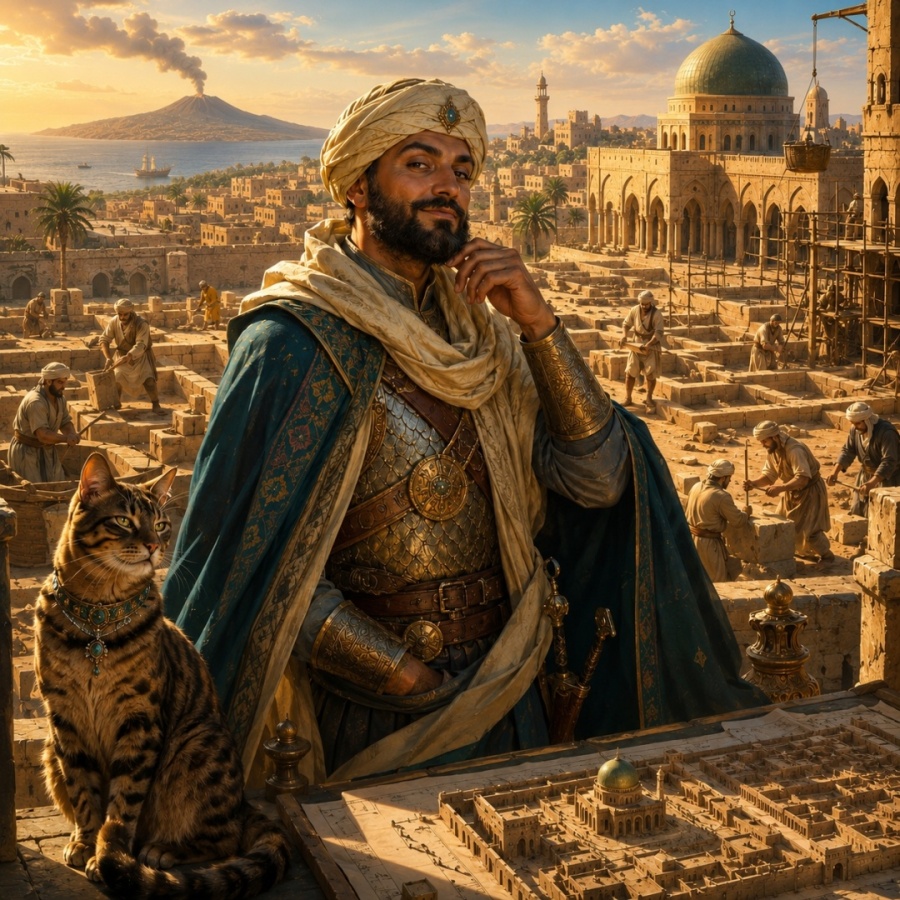
Jawhar al-Siqilli: The Sicilian General Who Founded Cairo
Jawhar al-Siqilli: The Sicilian-Linked General Who Laid the Foundations of Cairo
Some historical figures are famous because they wrote books, ruled kingdoms, painted masterpieces or lost battles in extremely memorable ways.
Then there is Jawhar al-Siqilli: the Fatimid general, administrator and governor who conquered Egypt in 969 and laid the foundations of the city that would become Cairo.
Which is not a bad item to have on a résumé.
Known as Jawhar al-Siqilli, “Jawhar the Sicilian,” he was one of the most important military and political figures of the tenth-century Mediterranean. His life connects the Byzantine world, Sicily, North Africa, Egypt and the wider Islamic world in a way that makes modern travel itineraries look rather lazy.
But let us be precise, because history enjoys punishing careless summaries.
Jawhar was not simply “a Sicilian” in the modern, clean, passport-ready sense. His nisba al-Siqilli links him geographically to Sicily, while another nisba, al-Saqlabi, “the Slav,” reflects traditions connecting him with Slavic or Balkan origins. He was born before 900, probably somewhere within the Byzantine Empire, possibly in Byzantine-controlled Sicily. His family was Christian and non-Arab, and he was later enslaved and deported to Ifriqiya, in North Africa.
So yes, the label “Sicilian” is there. But medieval identity was not exactly designed for quick tourist brochures.
He was not a king. He was not a caliph. He did not inherit an empire wrapped in silk and flattering poetry.
He helped build one.
A Man Between Sicily, Byzantium and the Fatimid World
Who was Jawhar al-Siqilli?
Jawhar al-Siqilli was a leading general, administrator and trusted servant of the Fatimid Caliphate, the powerful Ismaili Shi‘i dynasty that rose in North Africa and eventually conquered Egypt.
His name, al-Siqilli, means “the Sicilian,” and this is what makes him especially fascinating for Sicilian history. But it should be understood as a geographical attribution, not as a neat modern biography. Medieval names often tell us something important, but rarely everything we want.
Because apparently even the Middle Ages enjoyed making historians work for their dinner.
Jawhar’s early life is not perfectly clear. He was born before 900, and later sources suggest that he lived to be more than eighty years old. His origins were Christian and non-Arab; he was enslaved, taken to Ifriqiya and eventually entered Fatimid service.
Some traditions connect him with Sicily, probably under Byzantine control at the time of his birth. Others emphasize his nisba al-Saqlabi, which may point toward Slavic or Balkan associations. In short: he belonged to the messy, mobile, multilingual Mediterranean world where identities travelled almost as much as armies did.
What is clear is that Jawhar rose from slavery into one of the most powerful military and administrative roles in the Fatimid state.
That is not a career ladder. That is a vertical launch.
Sicily was not a footnote
Jawhar’s story reminds us that early medieval Sicily was deeply connected to the wider Mediterranean. The island was not an isolated place quietly waiting to become a postcard. It was a strategic world of languages, trade, conflict, religion, migration and ambition.
In other words, Sicily was already complicated.
Very on brand.
The fact that a man remembered with the name “the Sicilian” could become one of the great commanders of the Fatimid world is not an accident. It is evidence of how central Sicily and the central Mediterranean were to wider networks of power.
The Fatimids: Ambition With Excellent Logistics
A caliphate looking east
To understand Jawhar, we need to understand the Fatimids. The Fatimid Caliphate emerged in North Africa and claimed descent from Fatima, daughter of the Prophet Muhammad. It was not simply another regional power. It presented itself as an alternative universal caliphate, a rival to the Abbasids in Baghdad.
In medieval politics, this is the diplomatic equivalent of entering a room and saying: “Actually, we should be in charge.”
The Fatimids controlled important territories in North Africa, but Egypt was the great prize. Rich, strategic, fertile, linked to the Red Sea, the Mediterranean and the routes of commerce, Egypt was not just another province.
Egypt was the key to a much larger imperial project.
Jawhar’s rise under al-Mu‘izz
Jawhar became especially important under the Fatimid caliph al-Mu‘izz li-Din Allah. As a military commander, he led major campaigns in North Africa and proved himself capable of both conquest and administration.
This combination mattered. Many people can conquer a place. Fewer can keep it functioning afterward without everything immediately catching fire, metaphorically or literally.
Jawhar was not simply a sword with good posture. He was also an organizer, planner and political operator.
Exactly the sort of person an ambitious caliphate needs when it decides to take Egypt.
The Conquest of Egypt in 969
A campaign that changed history
In 969, Jawhar led the Fatimid army into Egypt. The campaign succeeded, and Egypt passed under Fatimid control.
This was one of the major turning points of medieval Mediterranean history. With Egypt in their hands, the Fatimids gained a rich and strategic base from which they could project power across the eastern Mediterranean, the Red Sea and the Islamic world.
For Jawhar, it was the achievement that would secure his name in history.
For Egypt, it was the beginning of a new political and cultural chapter.
For the Abbasids, one imagines it was an unpleasant morning.
Conquest without unnecessary chaos
One of the striking aspects of Jawhar’s success is not only that he conquered Egypt, but that he helped stabilize the transition. Military conquest is one thing. Turning victory into government is another.
Jawhar became the Fatimid governor and effective viceroy of Egypt from 969 to 973, ruling with extensive administrative powers until the arrival of al-Mu‘izz.
That meant maintaining order, dealing with local elites, managing finances, organizing supplies, securing the army and preparing a new capital worthy of Fatimid ambition.
Because apparently conquering Egypt was not enough for one decade. He also needed to start building a city.
Some people really do make the rest of us look unproductive.
The Foundations of Cairo
6 June 969: a new city begins
After the conquest, Jawhar ordered the foundation of a new fortified city northeast of the older settlement of Fustat. The foundation is traditionally dated to 6 June 969.
This city would become Cairo, one of the great capitals of world history.
At first, the new city was closely tied to the Fatimid court, army and ruling elite. It was designed not simply as a normal urban extension, but as a seat of power: organized, strategic and symbolic.
In other words, it was not just “let’s build some houses over there.”
It was imperial urban planning.
With walls.
From al-Mansuriyya to al-Qāhira
The new city was initially connected to the model and memory of al-Mansuriyya, the Fatimid capital in North Africa. That detail matters, because Jawhar was not inventing urban power from nothing. He was transferring and adapting a Fatimid political model to Egypt.
The city later became known as al-Qāhira, “the Victorious,” the name from which Cairo derives.
It is an excellent name, frankly.
Very confident.
Not “New Administrative Settlement Near Fustat,” which would have been accurate but less inspiring.
“The Victorious” has slightly more ambition.
Jawhar and the birth of Cairo
It is safest to say that Jawhar laid the foundations of Cairo. He planned and began the construction of the new Fatimid city after the conquest of Egypt.
Later rulers expanded it, transformed it and filled it with palaces, mosques, markets, institutions and life. Cairo became much larger than Jawhar’s original project.
But the beginning belongs to him.
A man linked to Sicily stood at the birth of one of the most important cities in the world.
That sentence should probably be better known in Sicily.
Al-Azhar: Mosque First, University Much Later
The construction ordered in 970
During the early Fatimid period in Egypt, Jawhar ordered or launched the construction of al-Azhar Mosque in 970. It was completed and inaugurated about twenty-two months later, in 972/973, under the caliph al-Mu‘izz.
This distinction matters.
Jawhar did not “found al-Azhar University” in the modern sense. The famous educational institution developed later. At this stage, al-Azhar was first and foremost a mosque within the new Fatimid capital.
Medieval history, once again, refuses to fit neatly into a simplified caption.
From mosque to global institution
Today, al-Azhar is associated with scholarship, theology, law and education on a global scale. But that later role grew over time from its origins as a Fatimid mosque in the new city.
Jawhar’s role belongs to the beginning of that story: the construction of the mosque as part of the new Fatimid urban and ideological project.
This is still impressive enough. There is no need to exaggerate.
He helped conquer Egypt.
He governed it for four years.
He laid the foundations of Cairo.
He ordered the construction of the mosque that would later become associated with one of the most important centers of Islamic learning in the world.
At some point, one has to ask whether medieval CVs were allowed to be this impressive.
A city built for ideology
Cairo was not only a military or administrative project. It was also ideological. The Fatimids needed a capital that expressed their legitimacy, authority and religious identity.
Urban space mattered. Mosques mattered. Ceremonies mattered. Architecture mattered.
Power, in the medieval world, was not only exercised. It was staged.
Jawhar helped build the stage.
Jawhar as Governor: The Less Glamorous Part That Actually Matters
Holding Egypt together
Conquest gets the dramatic music. Administration gets the paperwork.
Unfortunately for people who prefer heroic simplicity, paperwork often decides whether history lasts longer than a week.
After taking Egypt, Jawhar governed on behalf of the Fatimids from 969 to 973. This meant dealing with local elites, religious communities, finances, food supply, military order and the many delicate problems that appear once the battle is over and everyone expects life to continue.
He had to make Fatimid rule functional.
Which is less cinematic than cavalry and banners, but probably more difficult.
The viceroy before the caliph
Before al-Mu‘izz arrived in Egypt in 973, Jawhar effectively acted as the Fatimid viceroy and governor. He prepared the ground for the caliph’s transfer from North Africa to the new Egyptian capital.
This required loyalty, competence and an unusual ability to not ruin everything before the boss arrived.
A rare skill in every century.
When al-Mu‘izz finally entered Egypt, the Fatimid state had a new center, a new capital and a much stronger position in the Islamic world.
A Sicilian-Linked Man Who Changed Egypt
Why Sicily should remember him carefully
Jawhar al-Siqilli is one of those figures who should appear more often in Sicilian storytelling, but with the right historical caution.
Sicily loves to remember Greeks, Romans, Normans, Baroque cities, volcanoes, writers, saints, aristocrats and occasionally someone who invented or improved something edible. All excellent categories, naturally.
But the island also appears in the biographies of people who changed the wider Mediterranean world.
Jawhar is one of them.
His life shows that Sicily was not merely conquered by empires. It also stood inside the networks from which imperial history was made.
A Mediterranean biography
Jawhar’s story cannot be reduced to one modern identity box. He was linked to Sicily by the name al-Siqilli, associated in other traditions with the label al-Saqlabi, born in the Byzantine world, enslaved, taken to Ifriqiya, elevated in Fatimid service and finally tied forever to Egypt by conquest and urban foundation.
That is not a simple biography.
That is the Mediterranean doing what the Mediterranean does best: mixing routes, powers, languages, identities and destinies until modern categories politely give up.
Modern readers often want simple labels.
Medieval history, with great satisfaction, refuses.
Jawhar was not simple.
That is precisely why he is interesting.
The Irony of a Forgotten Founder
Everyone knows Cairo. Few know Jawhar.
Here is the irony: almost everyone has heard of Cairo. Far fewer people have heard of Jawhar al-Siqilli.
This is history being slightly rude.
One of the world’s great cities exists because of a series of political decisions, military campaigns and urban planning choices in which Jawhar played a central role. Yet his name is often absent from popular memory.
Tourists visit Cairo. Scholars study Cairo. Films show Cairo. News reports mention Cairo daily.
But the man who laid its foundations remains, for many people, a footnote.
A very large footnote, admittedly. One with walls, mosques and several million residents.
Founders often disappear
This happens often. Cities outgrow their founders. Institutions outgrow their builders. Names fade while streets, walls and stories continue.
Jawhar’s case is particularly striking because Cairo became enormous: politically, culturally, religiously and symbolically.
The city became bigger than the man.
Which is normal.
But it does not mean the man should vanish.
Jawhar, Sicily and the Islamic Mediterranean
A broader Sicilian story
For travelers and readers interested in Sicilian history, Jawhar opens a door onto a world that is often simplified.
Islamic Sicily was not just an interval between Byzantine and Norman rule. It was part of a wider Mediterranean system that reshaped agriculture, language, architecture, administration, food, settlement patterns and cultural connections.
It also produced — or at least helped identify — stories like Jawhar’s.
Stories of mobility. Stories of power. Stories of people who crossed cultures and changed maps.
This is why Sicily’s past is so fascinating. It refuses to stay local.
From Sicily to Cairo, from island to empire
Whether Jawhar’s precise early origins are placed in Byzantine Sicily, the broader Byzantine world or within traditions connected to Slavic and Balkan identity, his name and memory tie him unmistakably to Sicily through al-Siqilli.
From there, his life moved across the Fatimid Mediterranean and culminated in Egypt, where he governed, planned and began a city whose influence would last more than a thousand years.
That is a rather impressive journey.
Some people leave Sicily and send postcards.
Jawhar left the Sicilian memory trail and laid the foundations of Cairo.
Admittedly, standards were different.
Death and Legacy
The end of Jawhar’s life
Jawhar died in Cairo on 28 April 992, already an old man. If he was born before 900, as the sources suggest, he must have lived more than eighty years.
For the tenth century, that was impressive.
For someone who survived slavery, military campaigns, imperial politics, the conquest of Egypt and four years of governing one of the most strategic lands in the Mediterranean, it was almost suspiciously impressive.
A legacy larger than a name
Jawhar’s legacy is not only military. It is urban, administrative and symbolic.
He represents the Fatimid shift from North Africa to Egypt. He marks the beginning of Cairo as a political project. He stands at the opening of the Fatimid Egyptian chapter, one of the most important periods in medieval Islamic history.
And because of his name, he also remains connected to Sicily.
Not in a simple, patriotic, modern way.
In a much more interesting Mediterranean way.
Why Jawhar al-Siqilli Still Matters Today
A reminder of Sicily’s global history
Jawhar matters because he reminds us that Sicily has always been part of global history.
The island was not merely a destination. It was a crossroads, a platform, a laboratory of cultures and, sometimes, a name carried into the highest levels of imperial power.
Jawhar’s career connects Sicily to Byzantium, North Africa, Egypt and one of the greatest urban foundations of the medieval world.
That makes him more than a curiosity.
He is a symbol of Sicily’s Mediterranean reach.
History beyond the postcard
Modern Sicily is often marketed through beaches, food, volcanoes and ruins. All wonderful, of course. We are not here to insult beaches, food, volcanoes or ruins. That would be unwise and, frankly, ungrateful.
But Sicily is also made of complex biographies, forgotten names, cross-cultural lives and stories that connect the island to the fate of empires.
Jawhar al-Siqilli belongs to that deeper Sicily.
The Sicily that does not fit neatly into a souvenir magnet.
Which is usually the most interesting Sicily.
Final Thought: The Sicilian Name Behind Cairo
Jawhar al-Siqilli’s life is extraordinary because it stretches across worlds.
From the Byzantine Mediterranean to slavery in Ifriqiya, from Fatimid service to North African campaigns, from the conquest of Egypt to the foundation of al-Qāhira, his story is one of movement, strategy and transformation.
He was a general, governor, administrator and political instrument of a vast imperial project.
He helped bring Egypt into the Fatimid world.
He laid the foundations of the city that became Cairo.
He ordered the construction of al-Azhar Mosque, which would later grow into one of the most famous centers of Islamic learning.
And yet, outside specialist circles, his name remains surprisingly obscure.
History can be unfair like that. It remembers the city, forgets the planner, photographs the monument and loses the person holding the measuring rope.
So next time you hear the name Cairo, spare a thought for Jawhar al-Siqilli.
A man with a Sicilian name helped put that city on the map.
Quite literally.
🏛 Curious to discover Sicily beyond the obvious? Explore the island’s layered history, cultures and unexpected Mediterranean connections with Etna Unlimited.
Discover all our cultural and historical experiences in Sicily
Etna Unlimited Excursions & Tours