How Ancient Romans Explained Mount Etna
How Ancient Romans Explained Mount Etna: Lucretius and the First Scientific Theory of Volcanoes
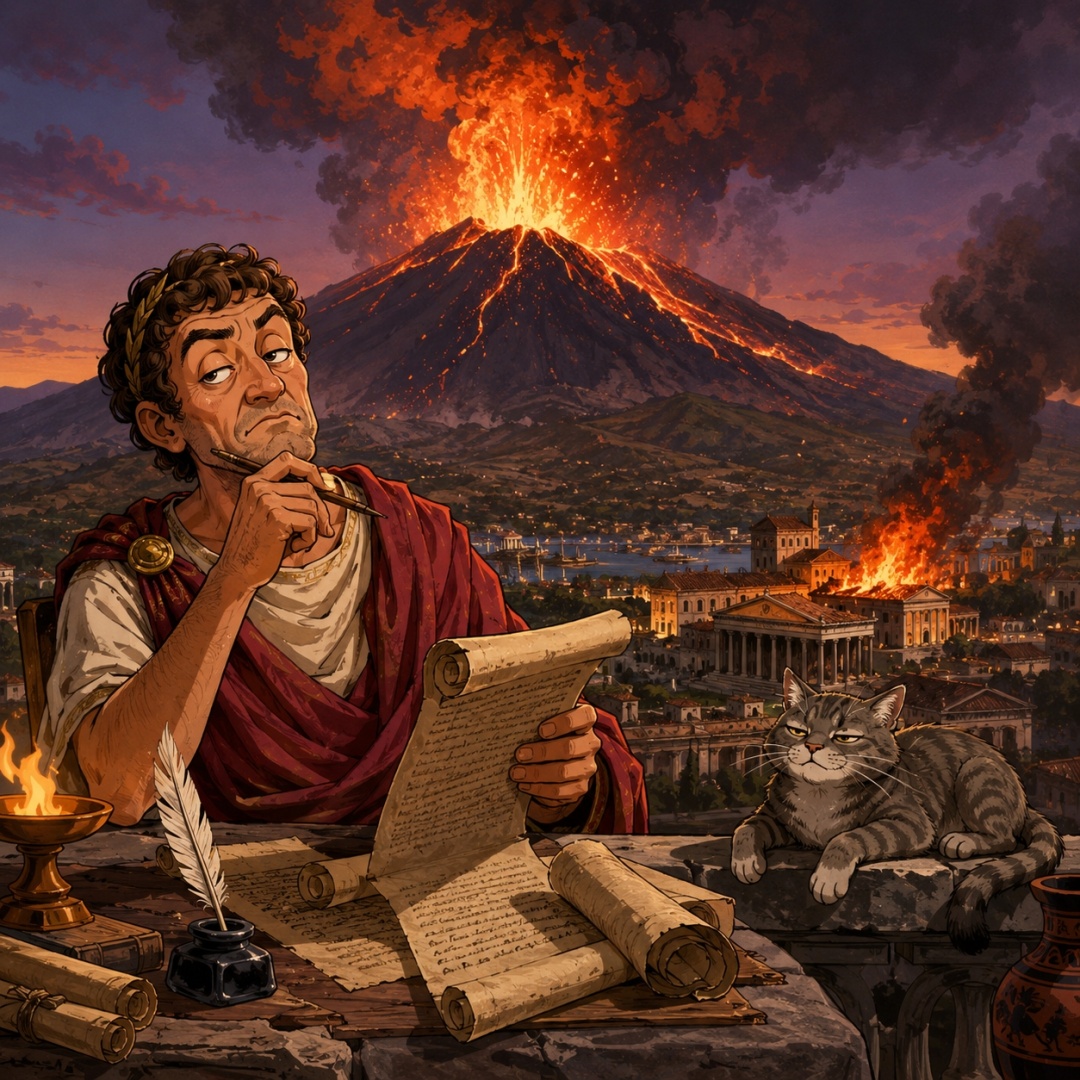
Long before modern volcanology existed, people were already trying to understand why volcanoes erupt. Among them was the Roman poet and philosopher Titus Lucretius Carus, who described the activity of Mount Etna in his famous philosophical poem De Rerum Natura.
Writing in the first century BCE, Lucretius attempted something remarkable for his time: explaining volcanic eruptions not through myth or divine anger, but through natural processes.
His interpretation was not scientifically accurate, but it represented one of the earliest attempts in Western history to describe volcanoes using rational observation.
Mount Etna in the Ancient World
The most famous volcano of the Mediterranean
In antiquity, Mount Etna was already famous across the Mediterranean world. Towering above eastern Sicily, its eruptions were visible from far across the sea.
For the Greeks and Romans, Etna symbolized both power and mystery. Mythology claimed the volcano was the forge of Hephaestus, the Greek god of fire, or the prison of giant monsters buried beneath the earth.
Yet some thinkers began to search for more logical explanations.
Among them was Lucretius.
The Philosophy Behind De Rerum Natura
Epicurean science in poetic form
In his masterpiece De Rerum Natura, Lucretius presented the philosophical ideas of Epicurus.
According to Epicurean philosophy:
-
the universe is composed of atoms
-
natural events have physical causes
-
the gods do not intervene in the workings of nature
This worldview aimed to free humanity from fear—especially the fear of supernatural forces.
Book VI of the poem is devoted to explaining natural phenomena such as storms, earthquakes, epidemics, and volcanic eruptions.
Mount Etna becomes one of the central examples.
Lucretius’ Description of an Etna Eruption
A surprisingly vivid observation
Lucretius describes Etna erupting with dramatic imagery:
-
flames bursting from the mountain
-
glowing rocks thrown into the sky
-
clouds of ash spreading across the landscape
The description is so vivid that many historians believe he was referring to a real eruption, possibly the eruption of 122 BCE, one of the most significant ancient eruptions of Mount Etna.
Even though the explanation was speculative, the observational details are strikingly accurate.
The Ancient Theory of Underground Winds
How Romans imagined volcanoes worked
To explain volcanic eruptions, Lucretius relied on a theory widely discussed in ancient philosophy.
According to this interpretation:
-
the interior of the mountain contained large underground caverns
-
these caverns were filled with air and violent winds
-
when the air became heated and turbulent, it generated fire
As pressure increased, molten material and flames were expelled through openings in the mountain.
In essence, an eruption was thought to be the result of a massive underground storm.
The Role of the Sea in Lucretius’ Theory
Lucretius also proposed an interesting connection between the sea and Mount Etna.
He believed that seawater from the eastern coast of Sicily could penetrate underground channels leading into the volcano. This water would compress the air trapped inside the mountain, increasing pressure and eventually triggering explosive eruptions.
Today we know that volcanic eruptions are driven by magma rising from deep within the Earth’s mantle, but the attempt to connect different natural processes shows how ancient thinkers sought rational explanations for complex phenomena.
Mount Etna as a Natural Laboratory of Antiquity
For ancient philosophers and scientists, Mount Etna represented a unique opportunity to study the forces of nature.
Its eruptions were frequent.
Its size was immense.
Its power was undeniable.
As a result, Etna became one of the most cited volcanoes in classical literature and philosophy.
Even before the eruption of Mount Vesuvius in 79 CE made history, Etna had already captured the imagination of scholars across the Mediterranean world.
From Ancient Philosophy to Modern Volcanology
Today, science understands that Mount Etna’s eruptions are caused by magma rising through a complex system of volcanic conduits connected to deep geological processes beneath the Earth's crust.
Modern volcanology explains:
-
magma pressure
-
tectonic plate movement
-
volcanic gas expansion
Yet the work of Lucretius remains historically important.
It represents one of the earliest intellectual attempts to explain natural disasters without invoking supernatural forces.
In this sense, the poet of ancient Rome helped pave the way toward scientific thinking.
Experiencing Mount Etna Today
Today, Mount Etna remains one of the most active volcanoes in the world and one of the most fascinating landscapes in Europe.
Exploring the volcano means walking through:
-
ancient lava fields
-
volcanic craters
-
landscapes shaped by thousands of years of eruptions
The same mountain that inspired philosophers in antiquity continues to attract travelers, scientists, and explorers from around the world.
And while our understanding of volcanoes has evolved dramatically, the sense of wonder remains unchanged.
Discover all our tour offers in Sicily and on the Etna volcano
Etna Unlimited Tours and Excursions