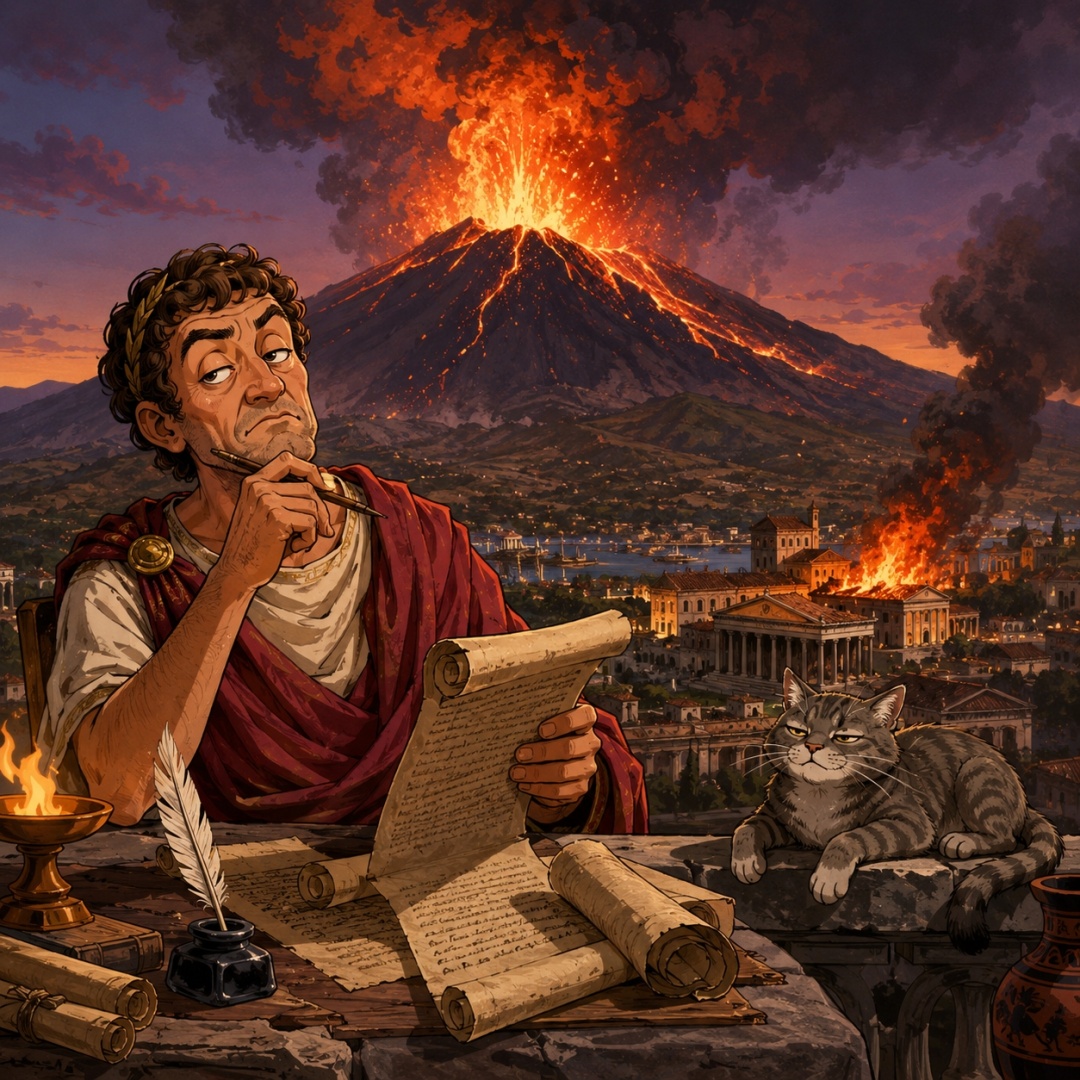
The Mount Etna eruption before Julius Caesars death
The Mount Etna Eruption That Darkened the Sun Before Julius Caesar’s Death
History remembers the assassination of Julius Caesar on the Ides of March, 44 BCE. Senators, daggers, betrayal, and a very unlucky toga. But while Rome was busy rewriting its political future, something even more dramatic may have been happening far away in Sicily.
Just days before Caesar’s death, Mount Etna appears to have produced one of the most powerful eruptions of the ancient world.
Ancient writers recorded strange and unsettling phenomena: a dim sun, a hazy sky, mysterious halos around the sun, and even the appearance of three suns in the sky. To Roman observers, these events were terrifying omens. Today, scientists suspect they may have been the atmospheric consequences of a massive volcanic eruption.
A Volcano Erupts on the Eve of History
Mount Etna has been active for hundreds of thousands of years, but certain eruptions stand out in the historical record. One of them likely occurred in early March of 44 BCE, just days before Caesar was assassinated in Rome.
Ancient authors describe Etna violently ejecting fire, rocks, and ash into the sky. The Roman poet Virgil, writing only a few years later, describes the volcano roaring with flames and molten rock pouring from its slopes.
The eruption was apparently powerful enough to affect large areas of the central Mediterranean. According to Pliny the Elder, glowing materials and ash were thrown high into the atmosphere, while fiery fragments rolled down the slopes of the volcano.
Some sources even suggest that ash and volcanic haze may have reached regions far beyond Sicily.
For people living in the ancient Roman world, such events were not simply geological phenomena. They were signs from the gods.
A Darkened Sun Over the Roman World
One of the most frequently reported phenomena in the sources is the strange appearance of the sun in the months following Caesar’s death.
The historian Plutarch writes that during the year of Caesar’s assassination, the sun appeared pale and weak for many months.
Instead of shining brightly, it produced little warmth. The air remained hazy, and the sky seemed dull and muted.
To ancient observers this was deeply unsettling. The sun was supposed to be stable, powerful, reliable. If even the sun appeared sickly, something must be terribly wrong with the world.
Modern volcanology offers a simpler explanation: large volcanic eruptions inject enormous quantities of fine particles into the atmosphere. These particles scatter sunlight and reduce its intensity, producing exactly the kind of dim and hazy skies described in ancient texts.
In other words, the Romans may have been observing the atmospheric consequences of Etna’s eruption without realizing it.
Three Suns in the Sky
Among the most curious reports from this period are descriptions of multiple suns appearing in the sky.
Several Roman and Greek authors mention that observers saw two or even three suns at the same time. The phenomenon is described by writers such as Pliny the Elder, Cassius Dio, and later chroniclers.
To Roman readers, this was clearly a prodigy — a supernatural sign announcing dramatic political change.
Modern science, however, recognizes these events as parhelia, often called sun dogs.
These bright spots appear when sunlight passes through ice crystals suspended in the atmosphere. Under certain conditions they can produce luminous companions on either side of the sun, giving the impression that several suns are visible at once.
Volcanic eruptions can increase the amount of particles and aerosols in the atmosphere, making these optical phenomena more common.
To a Roman farmer looking up at the sky in 44 BCE, however, the explanation was simpler:
The universe had gone slightly mad.
Halos, Ash, and an Unusual Sky
Ancient texts also mention luminous rings around the sun, colored halos, and strange atmospheric effects.
The philosopher Seneca describes circular halos of different colors surrounding the sun. Similar observations appear in the writings of Ovid, Velleius Paterculus, and Orosius.
These rings were interpreted as celestial warnings, but modern atmospheric physics again offers a more earthly explanation.
Fine volcanic particles suspended high in the atmosphere can produce complex optical effects, including halos, colored arcs, and unusual scattering of sunlight.
When combined with ice crystals in the upper atmosphere, the result can be a sky filled with luminous rings and ghostly suns.
In short: a spectacular natural light show.
Unfortunately for the Roman Republic, the political situation in Rome was already explosive enough without help from the volcano.
Could Etna Have Changed the Climate?
Modern research suggests that the eruption of Etna in 44 BCE may have had measurable climatic effects.
Evidence from tree rings in North America indicates a period of cooler temperatures around 43–42 BCE. Meanwhile, ice cores from Greenland show spikes in volcanic acidity that could correspond to major eruptions during this period.
While the exact volcanic source remains debated, some researchers believe the Etna eruption may have contributed to these atmospheric changes.
If so, the eruption did more than frighten ancient observers.
It may have briefly altered the climate of the Northern Hemisphere.
When Volcanoes and History Collide
The year 44 BCE was already one of the most dramatic years in Roman history.
Caesar was assassinated.
The Roman Republic began its final collapse.
Civil wars soon followed.
And high above it all, the sky itself seemed to behave strangely.
To the Romans, these events were deeply connected. Earthquakes, comets, strange suns, and volcanic eruptions were interpreted as divine warnings or cosmic reactions to human events.
Modern science separates politics from geology. Volcanoes erupt because of magma, not senators.
Still, the coincidence is irresistible.
While Rome was busy changing the course of Western history, Mount Etna was quietly reminding everyone that nature often writes the most dramatic chapters.
Exploring Mount Etna Today
More than two thousand years later, Mount Etna remains one of the most active volcanoes on Earth.
Visitors walking across its lava fields today are quite literally exploring the same volcanic landscape that fascinated ancient writers such as Virgil, Seneca, and Pliny.
The eruptions are still spectacular. The landscapes are still dramatic. And the volcano continues to shape the environment of eastern Sicily.
The difference is that today we understand what is happening beneath the surface.
More or less.
Explore Mount Etna with a local guide
Etna Unlimited Tours and Excursions