Ovid and Mount Etna: The Forgotten Eruption Around 24 BC
Ovid and Mount Etna: The Forgotten Eruption Seen by a Young Roman Poet
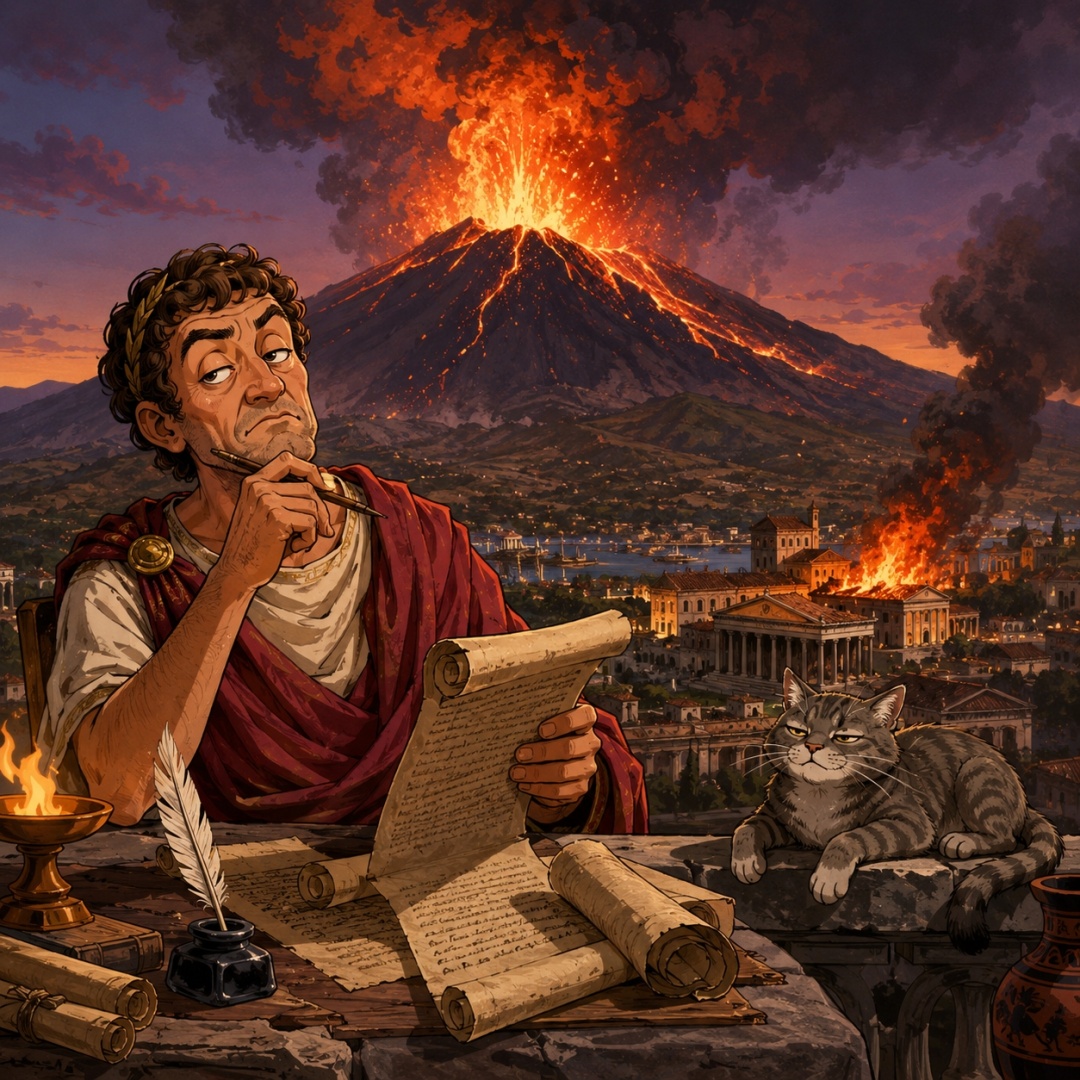
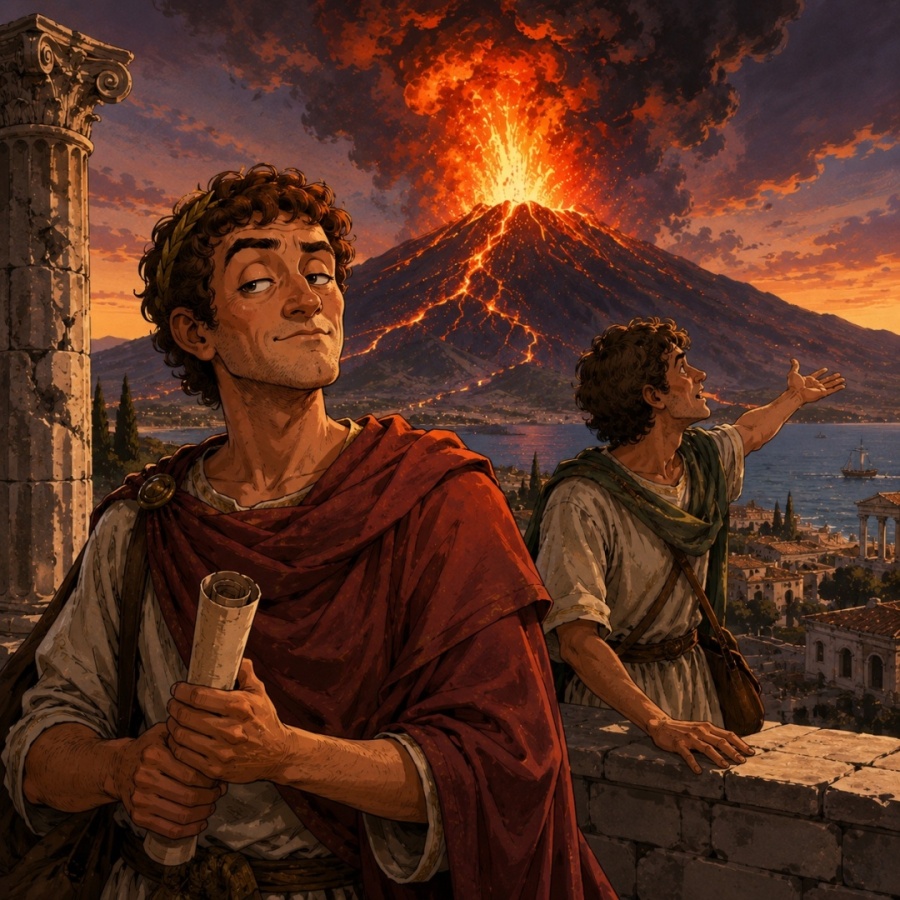
Around 24 BC, long before exile, sorrow, and literary melancholy turned him into one of Rome’s most famous poets with excellent reasons to complain, Ovid traveled through Sicily with his friend Macro.
During that youthful journey, according to his own later memory, he saw Mount Etna in activity. Not as an abstract myth. Not as a decorative mountain in the background of a poetic metaphor. He saw the volcano burning.
In the Epistulae ex Ponto, written years later from exile on the Black Sea, Ovid recalls having seen the sky shine because of the flames of Etna. It is a short passage, almost hidden inside an autobiographical memory, but it may preserve a precious witness account of an ancient Mount Etna eruption that escaped several modern catalogues.
Which is very Etna, honestly. Even when ancient Rome was carefully writing things down, the volcano still found a way to appear in the margins and make historians work harder two thousand years later.
A Poet, a Journey, and a Volcano That Refused to Behave
Ovid in Sicily
Ovid, born in 43 BC, is best known as the author of works such as the Metamorphoses, the Amores and the Ars Amatoria. Elegant, brilliant, playful and occasionally too clever for his own good, he became one of the defining literary voices of Augustan Rome.
But before the exile, before the imperial displeasure, before the endless poetic letters from the edge of the Roman world, there was travel.
In his youth, Ovid journeyed through Asia Minor and Sicily with a companion named Macro, probably a poet and friend. According to the later autobiographical memory preserved in the Epistulae ex Ponto, he stayed in Sicily for a considerable time and witnessed Etna in eruption.
This is not the usual image of Ovid. We tend to picture him in Rome, surrounded by elegance, wit, love poetry and dangerous literary confidence. Yet here he is, young and traveling in Sicily, looking at an active volcano like any sensible visitor and presumably thinking: “Well, that is difficult to ignore.”
Why this episode matters
The passage is important because it offers a rare ancient testimony of Etna volcanic activity from a literary source. It is not a technical report. Ovid was not a volcanologist, which is understandable, since volcanology had not yet done the polite thing and been invented.
But ancient volcanic history often depends precisely on this kind of evidence: a line in a poem, a historical aside, a memory preserved in exile, a note copied by later scholars.
Small? Yes.
Useless? Absolutely not.
The Source: Ovid’s Epistulae ex Ponto
Letters from exile
The source for this event is Ovid’s Epistulae ex Ponto, a collection of poetic letters written during his exile at Tomis, on the Black Sea, after he was banished by Augustus in 8 AD.
The work is far from a cheerful travel diary. Ovid writes from the margins of the Roman world, far from Rome, friends, literary circles and the life he once knew. The tone is often nostalgic, wounded and full of appeals to friends and patrons.
In that context, memory becomes powerful. Ovid looks back on earlier journeys, friendships and places visited in youth. Among those memories appears Sicily, and with Sicily, inevitably, the Etna volcano.
The letter to Macro
The relevant passage appears in a letter addressed to Macro, the companion of Ovid’s youthful travels. The identification of this Macro is not completely certain, but he may have been linked to the literary and cultural world around Ovid.
What matters for us is that Ovid recalls traveling with him, including through Sicily, and remembers seeing the impressive flame of Etna.
The scene is striking: an elderly poet in exile, writing from the cold margins of empire, remembers the fiery mountain of Sicily from his youth.
That is not just geography. That is literary contrast with excellent dramatic lighting.
What Did Ovid Actually See?
The sky shining with Etna’s flame
The passage remembered by the source refers to Ovid seeing the sky shine because of the flame of Etna. The image is vivid, even if concise: a glowing mountain, a luminous sky, fire visible enough to impress a young Roman traveler.
This suggests that the volcano was in clear activity during Ovid’s stay in Sicily. The text does not describe lava destroying towns, ash covering cities or major casualties. Instead, the emphasis is visual: flame, brightness, spectacle.
In other words, Etna was performing.
And Ovid, naturally, noticed. Poets are professionally vulnerable to dramatic lighting.
Probably summit activity
The event is usually interpreted as moderate summit activity. That means the eruption likely occurred at or near the summit area, producing visible fire or incandescent activity without necessarily causing large-scale destruction on the lower slopes.
This fits the nature of the testimony. Ovid does not speak of villages buried by lava or fields ruined by fire. He remembers the visual power of the mountain.
It may have been a spectacular but relatively limited eruption, impressive enough to enter memory, but not catastrophic enough to dominate historical records.
Etna has always had range. Sometimes it destroys villages. Sometimes it simply lights up the sky and lets poets do the rest.
Dating the Event: Why Around 24 BC?
A biographical reconstruction
The eruption is usually placed around 24 BC, based on a reconstruction of Ovid’s youthful travels. The dating is not as firm as a consular entry in a historical chronicle, but it is plausible.
The reasoning is biographical: Ovid refers to travels made in his youth, in the company of Macro, including Sicily. Modern scholarship has used the available information about his life and literary chronology to suggest that this Sicilian journey took place around 24 BC.
So, we should be honest: this is not a date carved into lava by an extremely helpful Roman official.
It is a reasoned historical approximation.
“Around 24 BC” is the safest formula
For this reason, the best way to present the event is as an eruption or volcanic activity of Etna around 24 BC, witnessed or remembered by Ovid.
This wording avoids pretending we have more certainty than the sources allow. It also respects the nature of the evidence: literary, autobiographical and retrospective.
Ancient history often works like this. You do not always get a perfect date, a map and a damage report. Sometimes you get a poet in exile remembering fire.
And frankly, that is not a bad source of atmosphere.
An Eruption Missing from Modern Catalogues
A testimony that slipped through the cracks
One of the most interesting aspects of this event is that it appears to have been missed by several modern catalogues of Etna eruptions.
The reason is understandable. The passage occurs in a literary and partially mythological context, not in a formal historical account of volcanic damage. Scholars looking for clear eruption reports may have overlooked it or treated it as poetic decoration rather than a possible volcanic observation.
Which is fair, but also slightly dangerous. Ovid may be poetic, but that does not mean he was inventing the volcano.
Literature as volcanic evidence
This is why ancient literary sources must be handled carefully. Poets use images, exaggeration and mythological associations. But they can also preserve real observations.
In Ovid’s case, the memory of Etna’s flame may reflect an actual episode of volcanic activity observed during his journey in Sicily.
The challenge is to separate metaphor from memory, poetry from topography, and literary beauty from geological fact.
Simple? Not exactly.
Interesting? Very.
Etna in the Roman Imagination
A mountain of myth, fire and explanation
For Romans, Etna was not merely a natural feature. It was one of the great fiery places of the Mediterranean imagination.
It was associated with mythological stories, underground fires, giants, divine punishment, volcanic marvels and philosophical speculation about the nature of the earth.
Writers used Etna as a symbol of power, danger, passion and transformation. The mountain appeared in poetry, geography, philosophy and historical memory.
In other words, Etna was already a celebrity volcano. It did not need a marketing department. It had smoke.
Ovid and the poetic Etna
Ovid’s mention of Etna fits into this broader literary world, but it also has a personal quality. He is not simply repeating a myth. He is remembering a journey.
That makes the passage particularly appealing. It sits somewhere between literature and lived experience, between classical imagery and travel memory.
A young poet sees a volcano. An older poet remembers it from exile. Two thousand years later, we try to decide whether the passage should be counted as evidence of an eruption.
History is rarely tidy. Fortunately, Etna is not tidy either.
What This Episode Tells Us About Ancient Etna
Not every eruption was a catastrophe
Modern readers often imagine volcanic eruptions only as disasters: lava destroying towns, ash darkening skies, people fleeing dramatically across the landscape.
Etna can do that. It has done that. It has never been short of ambition.
But the volcano also produces episodes of activity that are visually impressive without necessarily causing enormous destruction. Summit eruptions, glowing craters, fire fountains and night-time incandescence can leave strong impressions even when damage is limited.
Ovid’s memory may belong to this category: a powerful visual encounter rather than a major catastrophe.
The importance of minor eruptions
Minor or moderate eruptions are still important. They help reconstruct the volcano’s behavior over time and show how frequently Etna entered human awareness.
For ancient travelers, seeing Etna in activity was not just a scientific observation. It was an experience, a story, perhaps even proof that Sicily was not a place inclined toward moderation.
Which, to be fair, remains true.
Ovid, Exile and the Memory of Sicily
A fiery memory from a cold place
There is something moving in the contrast between Ovid’s exile and his memory of Sicily.
From Tomis, far from Rome and the Mediterranean world he loved, he recalls earlier journeys: youth, friendship, travel, Asia Minor, Sicily, Etna. The volcano appears not just as a landscape, but as part of a lost life.
That gives this eruption a different emotional tone from the dry notices of historians.
Cassius Dio gives us political fire. Ovid gives us remembered fire.
Both are useful. Ovid is just more dramatic about it, which is entirely on brand.
Why travelers still connect with this story
Today, travelers who visit Etna still experience something similar, even without Latin elegiac couplets involved. The volcano is not just seen; it is remembered.
People remember the black lava, the wind, the smell of volcanic rock, the strange silence of old craters, the view toward the sea, the feeling of standing on a mountain that is visibly alive.
Ovid’s memory reminds us that this reaction is not new. Etna has been entering travelers’ memories for thousands of years.
Some mountains are visited.
Etna gets lodged in the mind and refuses to leave.
Experiencing Ovid’s Etna Today
From ancient poetry to volcanic trails
To explore Etna today is to walk through a landscape that ancient writers already found astonishing.
Modern visitors can discover lava fields, extinct craters, forests, caves, volcanic deserts, vineyards and panoramic viewpoints. The mountain is both ancient and active, literary and physical, mythical and very real under your boots.
You do not need to know Ovid to enjoy Etna. But knowing that a young Roman poet once saw the volcano burning adds another layer to the experience.
Suddenly, the landscape is not just geological. It is cultural memory.
Etna as a living archive
Every eruption leaves traces: in rock, soil, vegetation, local memory and sometimes literature.
The episode around 24 BC reminds us that Etna’s history is not contained only in scientific catalogues. It also survives in poetry, letters, memories and fragments that need to be read with care.
That is what makes the volcano so fascinating. Etna is not only a mountain of lava. It is an archive of human reaction to fire.
And sometimes, that archive has excellent literary style.
Final Thought: When Poetry Becomes Volcanic History
The possible eruption of Etna around 24 BC, remembered by Ovid in the Epistulae ex Ponto, is a small but fascinating episode in the ancient history of the volcano.
It may not describe destruction on a massive scale. It may not provide a detailed volcanic report. It may not satisfy anyone looking for neat certainty, which is unfortunate for neat people.
But it gives us something rare: a personal memory of Etna in activity, preserved by one of Rome’s greatest poets.
That is enough to matter.
Through Ovid, we glimpse a young traveler in Sicily, standing before a mountain alive with flame. Through his later words, written far from home, we see how deeply that vision remained in memory.
Etna burned.
Ovid remembered.
And two thousand years later, the volcano is still making sure nobody forgets it.
🌋 Curious to explore the volcano that impressed poets, historians and travelers for centuries? Discover Mount Etna with a local guide and walk through landscapes shaped by fire, memory and time.
Discover all our tours on Mount Etna and across Sicily
Etna Unlimited Tours and Excursions