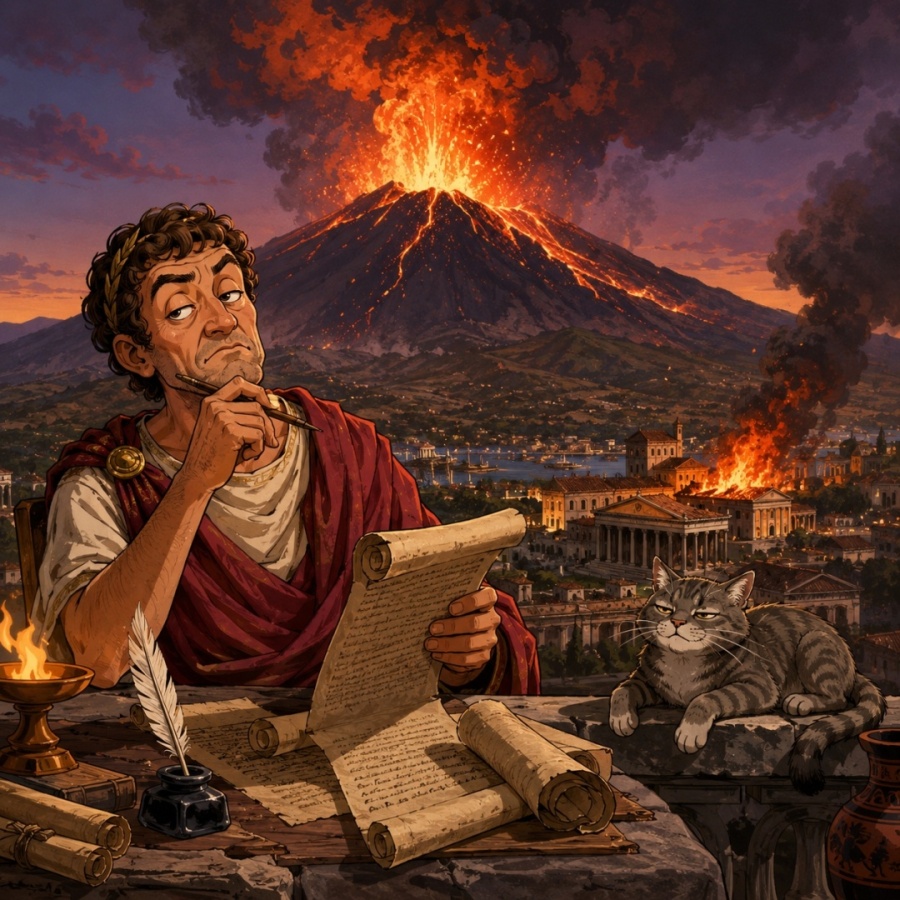
Mount Etna in 32 BC: The Eruption Recorded by Cassius Dio
Mount Etna in 32 BC: The Eruption That Burned Through Ancient Memory
In 32 BC, while Rome was tangled in political tension, omens, and the sort of imperial melodrama it practically invented, Mount Etna reminded everyone that Sicily had its own way of stealing the scene. According to the ancient historian Cassius Dio, an eruption struck the volcano and caused damage to villages and farmland, leaving behind one more fiery entry in the long and unruly history of Etna eruptions.
It is not the most famous eruption in the volcano’s past. It does not enjoy the blockbuster fame of later cataclysms. But it matters. A great deal, in fact. Because this event shows how the ancient world remembered natural disasters: not with modern seismographs and satellite images, but through historians, political context, scattered references, and a healthy dose of apocalyptic flair.
Mount Etna and the Ancient Talent for Terrible Timing
A volcano with impeccable dramatic instincts
Mount Etna has never been a shy mountain. Rising above eastern Sicily, it has spent millennia erupting, reshaping the land, terrifying onlookers, and quietly preparing the soil that would later produce vineyards, pistachios, orchards, and the sort of landscapes that make travelers reach for their cameras before their coffee.
But in antiquity, Etna was more than a volcano. It was a force of nature wrapped in mythology, fear, and speculation. Greeks and Romans alike treated it as a place where the earth did not merely exist. It behaved. Loudly.
Why the year 32 BC matters
The eruption of 32 BC unfolded during a highly volatile moment in Roman history, just before the final clash between Octavian and Mark Antony. In other words, the Mediterranean world was already having a stressful year. Then Etna entered the chat.
Ancient authors often grouped volcanic events with other prodigies and disasters, as though the universe had assembled an especially aggressive editorial calendar. That is exactly the atmosphere surrounding this eruption.
The Ancient Source: Cassius Dio and His Fiery Note
Who recorded the eruption?
The main testimony for this eruption comes from Cassius Dio, the Greek-speaking Roman historian who wrote an extensive Roman History in 80 books. Writing centuries after the event, Dio included the eruption in a broader discussion of ominous signs and alarming occurrences in Italy and the Roman world.
That context is important. He was not writing a volcanology manual. He was writing history, and ancient history had a habit of treating eruptions, strange celestial signs, political upheaval, and urban fires as part of the same cosmic mood swing.
What does the source actually say?
In essence, the account recalls that many places were destroyed by fire, and that there was also a very large outburst of fire from Etna, which damaged cities and countryside. The wording is concise, but the implications are vivid. This was not merely a decorative puff of smoke. It was an eruption serious enough to enter historical memory as a damaging event.
And, because antiquity rarely missed an opportunity to be dramatic, the memory of the eruption became associated with another blaze in Rome. Fire in Sicily. Fire in the capital. One can almost hear the ancient chroniclers saying, “Yes, this seems symbolically appropriate.”
Dating the Eruption: Why Scholars Place It in 32 BC
History, not guesswork
The eruption is generally dated to 32 BC thanks to the mention of the consuls Gnaeus Domitius Ahenobarbus and Gaius Sosius. That chronological anchor helps scholars place the event with reasonable confidence.
Compared with some ancient eruptions, which float through the record like half-remembered nightmares, this one is relatively well framed. It sits in a specific political year, during a period when Rome was deeply preoccupied with power, civil conflict, and the question of who would end up ruling the whole show.
A small source, a useful eruption
Even a brief source can be historically valuable. In the case of Mount Etna’s 32 BC eruption, a short notice tells us several things at once: that the eruption was destructive, that it affected human settlement and agriculture, and that it was significant enough to be preserved in historical writing.
That may sound modest, but for ancient volcanology it is gold. Or at least bronze. Solid, respectable bronze.
What the Eruption Likely Did
Damage to villages and farmland
The surviving description indicates that the eruption damaged settlements and agricultural land. Specific place names are not preserved, which is frustrating in the way ancient history often is. Still, the reference to countryside destruction strongly suggests that the eruption had real local consequences, not just visual spectacle.
That matters on Etna. The volcano has always been both destructive and generous. It ruins land, then enriches it. It threatens communities, then helps sustain them. It is, in short, the most Sicilian possible contradiction: dramatic, fertile, dangerous, beautiful, and never inclined toward moderation.
Fire as the defining image
The language surrounding the event emphasizes fire, which is entirely fitting for Etna. Ancient observers were naturally drawn to what they could see most vividly: flames, burning landscapes, incandescent material, and devastation written across fields and slopes.
No one in 32 BC was discussing magma chemistry over a field notebook. They saw burning force, and they wrote burning force.
Why no named towns?
The lack of named locations may simply reflect the nature of the source. Cassius Dio was summarizing events, not compiling a local Sicilian damage report. Ancient historians were often more interested in the broader significance of a disaster than in producing neat municipal inventories.
Annoying for modern readers? Absolutely. Characteristically ancient? Also yes.
Etna, Rome, and the Ancient Love of Omens
When eruptions became political atmosphere
One of the most fascinating aspects of this eruption is the way it appears in a larger atmosphere of prodigies. In the ancient world, natural disasters were rarely treated as isolated phenomena. They were signs. Signals. Cosmic side-eyes.
So when Etna erupted and Rome also suffered a destructive fire, the connection became irresistible. Whether or not the two events were physically related was almost beside the point. Symbolically, they belonged together. The earth was restless, the state was unstable, and history seemed to be staging a very expensive production.
Ancient interpretation versus modern science
Today, volcanology explains eruptions through tectonic processes, magma ascent, gas pressure, and conduit dynamics. Ancient historians, understandably, preferred a more interpretive approach. They wrote about disasters as part of the moral and political climate of an age.
That does not make their testimony useless. Quite the opposite. It makes it richer. A record like this preserves not only an eruption, but also the mindset of the world that witnessed it.
Why This 32 BC Eruption Still Matters Today
A missing piece in Etna’s long story
The history of Mount Etna eruptions is not built only from the headline events. It also depends on shorter notices, fragmentary sources, and eruptions that survive in just a few lines of text. The 32 BC eruption of Etna is one of those pieces: compact, elusive, and surprisingly important.
It helps reconstruct the volcano’s ancient activity. It confirms that Etna’s destructive power remained a recurring concern in classical memory. And it reminds us that Sicily’s most famous mountain has been unsettling politicians, farmers, historians, and passersby for a very long time indeed.
The volcano that gives and takes
There is also a distinctly Sicilian irony here. The same volcano that can burn fields is the one that later nourishes some of the island’s most extraordinary landscapes and products. Around Etna today, travelers encounter vineyards, lava-stone villages, orchards, forest trails, and views that seem almost suspiciously picturesque.
But beneath that beauty lies an old truth: Etna is alive. It always has been. And every ancient eruption, including the one in 32 BC, is part of the reason the mountain still commands such respect.
Experiencing Etna Today
From ancient chronicles to living landscapes
Reading about Etna in ancient sources is one thing. Standing on its slopes is another. Today, visitors can explore lava fields, craters, birch forests, panoramic trails, and volcanic terrain that makes the planet feel wonderfully unfinished.
That is part of Etna’s enduring power. It is both a historical subject and a living experience. A place where the ancient world still feels close, and where every black lava flow seems to say, with minimal humility, “Yes, I’ve been doing this for thousands of years.”
For travelers interested in Sicily nature tours, Mount Etna excursions, and the deeper history of the volcano, Etna offers far more than scenery. It offers continuity: from classical authors like Cassius Dio to the modern traveler looking out across eastern Sicily and realizing that history here is never buried very deep.
🌋 Curious to discover the real Etna beyond the postcards? Explore the volcano with a local guide and experience the landscapes shaped by centuries of eruptions.
Discover all our tours on Mount Etna and across Sicily
Etna Unlimited Tours and Excursions