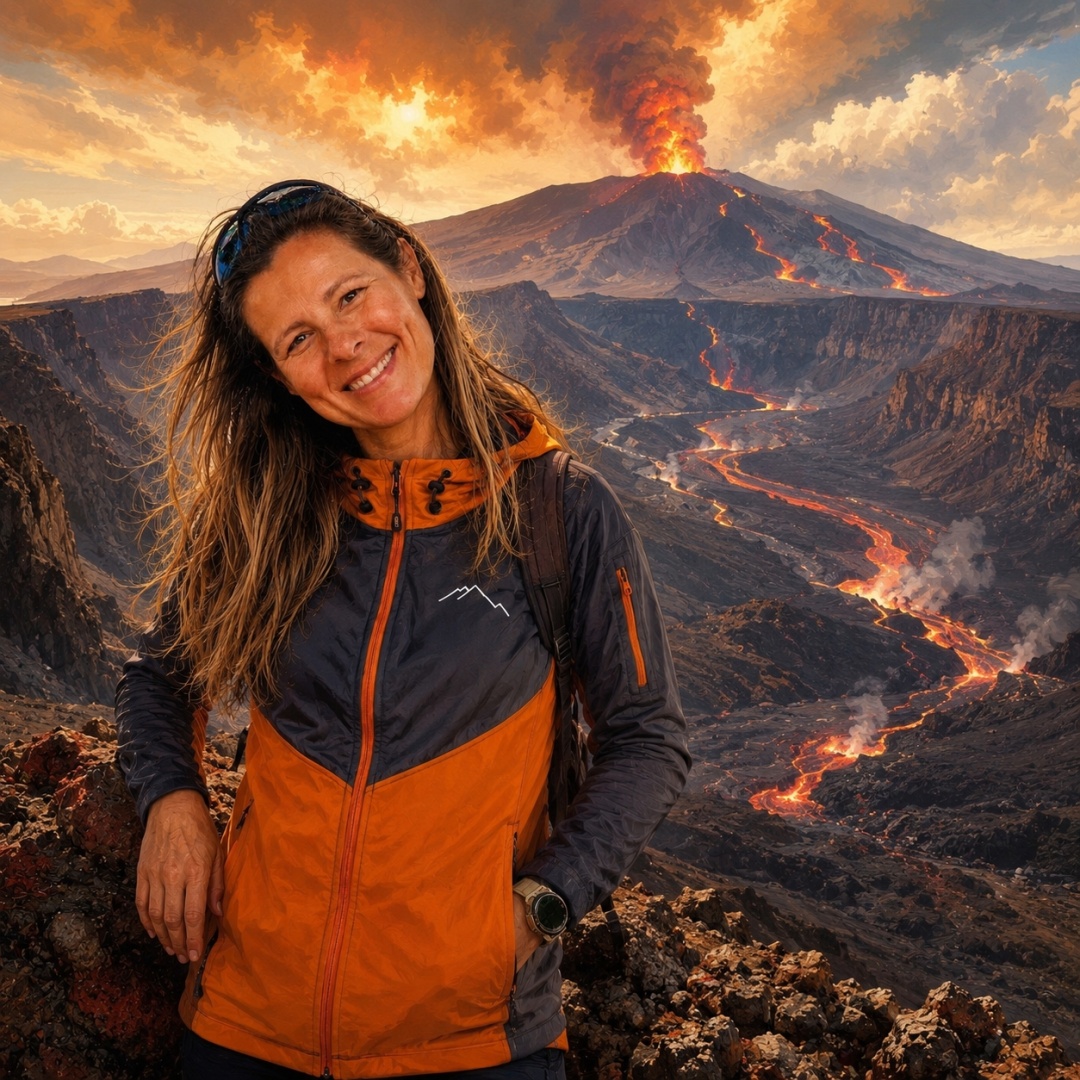
Mount Etna Eruption June 2026: Current Activity Explained
Mount Etna Eruption June 2026: Current Activity Explained
Mount Etna is active again, but not in the dramatic, movie-style way that many people imagine when they hear the word “eruption”.
There are no giant explosions lighting up the whole sky, no rivers of lava rushing toward towns, and no reason to imagine the volcano behaving like a special-effects department with a generous budget.
What began on Etna in June 2026 was more subtle, but still fascinating: a new effusive activity fed a lava flow in the upper eastern sector of the volcano, while the summit craters continued to show degassing, intra-crateric activity and occasional weak ash emissions. During the first days of July, the activity evolved further, with new vents, strombolian explosions and ash emissions in the summit area.
In simple terms: the activity began mainly as a lava-flow event in the summit area, but it later evolved into a more complex summit eruption, with strombolian activity and ash emissions between Voragine and the North-East Crater.
And, as often happens with Etna, understanding the details makes the volcano even more interesting.
This article explains how the June–July 2026 activity evolved on Mount Etna, where the lava came from, which craters were involved, why the map of the eruption matters, and what visitors should know before planning an excursion on the volcano.
This article is based on INGV monitoring data available at the time of writing, especially the weekly multidisciplinary bulletins issued on 30 June 2026 and 7 July 2026, and on the INGVvulcani article published on 8 July 2026 by the INGV Osservatorio Etneo. Volcanic activity can change quickly, so official updates should always be checked before visiting Etna.
Update: 8 July 2026
The activity evolved significantly during the first days of July. According to the INGV weekly bulletin issued on 7 July 2026 and the INGVvulcani article published on 8 July 2026, the effusive activity from the vent at about 3030 metres above sea level, which had started on 26 June, continued during the week and ended on 4 July.
By that time, the lava field had reached a maximum length of about 1.2 km, with the most advanced front at approximately 2605 metres above sea level. The mapped lava field covered an area of about 0.87 × 10⁵ m² and produced an estimated volume of about 2.6 × 10⁵ m³, with an uncertainty of about 40%.
INGV also explains that, by 2 July, the lava field had become more complex than in the first days of the eruption, with overlapping lava flows, lava tunnels and several short-lived ephemeral vents feeding secondary flows.
The same sources report new activity between the Voragine crater and the North-East Crater: a small lava flow from a vent at about 3200 metres opened on 2 July and stopped on the morning of 3 July, while a new eruptive fissure opened on 5 July between the eastern rim of Voragine and the North-East Crater.
This new fissure produced continuous strombolian activity, volcanic ash emissions and a small lava flow, about 180 metres long, which poured inside the North-East Crater. The volcanic cloud reached about 4.5 km above sea level and dispersed mainly toward the southern and south-eastern sectors of the volcano, with ash deposits observed on parts of Etna’s flank. The ash fall also caused the temporary closure of Catania Airport.
The activity along the eruptive fissure gradually decreased from the afternoon of 6 July, together with the ash emission, and then stopped almost suddenly in the early afternoon of 7 July.
For this reason, the June 2026 eruption should now be understood as an evolving summit activity: it began as a mainly effusive lava-flow event, developed a more complex phase with strombolian explosions, ash emissions and new eruptive vents in early July, and then showed a rapid decline of the fissure activity between 6 and 7 July.
Latest status: the eruptive phase has come to a pause
The latest INGVvulcani update, published on 8 July 2026, reports that the explosive and effusive activity along the eruptive fissure decreased from the afternoon of 6 July and stopped almost suddenly in the early afternoon of 7 July.
In other words, the June–July 2026 eruptive phase described in this article appears to have ended for now. But on Etna, “ended” does not mean that the volcano is asleep. It means that this specific phase has stopped, while the summit area remains active, monitored and capable of changing again.
That is why the best advice for visitors is still to stay updated, respect official restrictions and choose routes according to current volcanic and weather conditions.
What Happened on Mount Etna in June–July 2026?
From a mainly effusive eruption to a more complex summit activity
The June–July 2026 activity on Mount Etna began mainly as an effusive eruption. This means that lava was emitted from an opening or fracture and flowed over the surface of the volcano.
This is different from a strongly explosive eruption, where magma is fragmented and thrown high into the atmosphere, producing large ash columns, lava fountains or widespread ash fallout.
In this case, the first important feature was the lava flow that began on 26 June 2026 in the upper sector of the Valle del Leone, within the broader upper Valle del Bove area.
The lava was not coming from a random place on the volcano. It was linked to a system of fractures on the upper eastern side of the summit area, close to the Voragine crater sector.
According to the INGV bulletin issued on 7 July 2026, this first lava flow remained active until 4 July. During the same week, the activity evolved: a small vent opened at about 3200 metres between Voragine and the North-East Crater on 2 July, producing a short lava flow that stopped the following morning. On 5 July, a new eruptive fissure opened between the eastern rim of Voragine and the North-East Crater, producing strombolian activity, ash emissions and a small lava flow inside the North-East Crater.
This is one of the reasons why maps and topography are essential: on Etna, lava does not simply “go down the mountain” in a generic way. It follows slopes, channels, depressions and the morphology created by previous eruptions.
Where was the lava flow?
According to INGV observations, the first lava flow started from the terminal part of a fracture system at about 3030 metres above sea level.
The flow developed into the upper Valle del Leone, which is part of the high eastern sector of Etna and connected to the upper Valle del Bove system.
By 27 June, field surveys and drone images showed that the lava flow was about 630 metres long, with the most advanced front at around 2780 metres above sea level. A later survey on 29 June indicated that the most advanced front had reached an estimated elevation between 2750 and 2700 metres.
The 7 July INGV bulletin updated this picture: by the end of the main effusive phase, the lava field had reached a maximum length of about 1.2 km, with the most advanced front at approximately 2605 metres above sea level. The flow from the 3030 m vent gradually decreased and ended on 4 July.
These numbers are useful because they show the scale of the event. This was not a lava flow reaching inhabited areas or tourist villages. It was a summit-area lava flow, developing at high altitude on the eastern side of the volcano.
Which Craters Were Involved?
The summit area of Etna
Mount Etna’s summit area is not a single crater. It is a complex system made of several summit craters, each with its own behaviour and history.
The main summit craters include:
Cratere di Nord-Est — the North-East Crater, one of the highest and most important summit craters.
Voragine — a central crater that has played an important role in many recent phases of activity.
Bocca Nuova — another central summit crater, often divided into different internal sectors.
Cratere di Sud-Est — the South-East Crater, famous for many recent paroxysmal episodes and spectacular lava fountains in past years.
The June–July 2026 activity involved several parts of the summit system in different ways. The first lava flow was linked to the fracture system on the eastern side of the Voragine sector, while later activity developed between Voragine and the North-East Crater, with strombolian explosions, ash emissions and small lava flows.
Voragine and the fracture system
The most important area for understanding this activity is the eastern side of the Voragine and the area between Voragine and the North-East Crater.
INGV reports describe a system of fractures that had already formed between August 2025 and January 2026 and later propagated further toward the north-east and south-east. This fracture system is significant because the lava emission of 26 June 2026 started from its terminal part, at about 3030 metres.
The activity then evolved further in early July, with a small vent opening on 2 July at about 3200 metres between Voragine and the North-East Crater, followed by a new eruptive fissure on 5 July between the eastern rim of Voragine and the North-East Crater.
This means the eruption was not simply “from the top” in a generic sense. It was connected to specific structural weaknesses in the summit area, where fractures allow magma to reach the surface.
North-East Crater, Bocca Nuova and degassing
The North-East Crater showed intra-crateric explosive activity and intense degassing, with glows visible at night and occasional incandescent material falling back inside the crater.
Bocca Nuova had produced weak and episodic ash emissions earlier in June, especially around BN-1, although from 22 June no further emissions were observed in that sector according to the INGV bulletin issued on 30 June.
The Voragine area showed sporadic ash emissions earlier in the month and later intense degassing, with discontinuous strombolian activity observed from the pit on the upper eastern side of the crater during some phases. In early July, this area became even more important, with strombolian activity, ash emissions and the opening of new eruptive vents between Voragine and the North-East Crater.
In practical language: the summit area was active and complex. The public could observe white degassing, darker ash emissions when present, and, depending on weather and access rules, signs of lava activity in the high eastern summit sector.
Was This a Dangerous Eruption?
Not dangerous in the same way for everyone
The first important point is that volcanic risk depends on location.
An eruption in the summit area of Etna is not the same thing as an eruption affecting towns, roads or inhabited areas. The main lava flows described in the latest INGV bulletins developed at high altitude, in areas far from villages and urban zones.
That said, it would be wrong to say that there was “no danger”. On an active volcano, danger is never zero.
The summit area can be affected by sudden changes in activity, gas emissions, ash, unstable ground, poor visibility, rockfalls and rapidly changing weather conditions. Even when an eruption is not threatening towns, it can still be dangerous for people who approach the wrong area without proper guidance or updated information.
Why official restrictions matter
Access to Etna can change depending on volcanic activity, weather, ash emissions and official safety decisions. Authorities may limit access to certain altitudes or sectors of the volcano, especially near the summit craters and active lava fields.
This is not bureaucracy for the sake of bureaucracy.
It is because Etna can change quickly.
A route that is acceptable one week may become restricted the next. A viewpoint that is safe under one wind direction may become unsuitable if gas or ash moves toward it. A lava flow may appear slow and calm, but the surrounding terrain can still be unstable and hazardous.
The 7 July INGV bulletin also underlined that the phenomena could evolve rapidly and unpredictably, with possible more energetic activity, eruptive columns, ash clouds and instability in parts of the summit cones. This is why official restrictions are not optional details, but an essential part of visiting Etna safely during an active phase.
For visitors, the best approach is simple: check official updates, follow local regulations, and go with qualified professionals when visiting active volcanic areas.
Why This Eruption Is Interesting
It shows how Etna breathes through fractures
This eruption is interesting because it shows one of Etna’s most characteristic behaviours: magma can rise through the summit system and emerge through fractures on the upper flanks of the volcano.
The lava is not necessarily emitted from the main crater rim in a spectacular fountain. Instead, it can come out from a fracture lower down, feeding a lava flow that follows the slope. Then, as happened in early July, the activity can migrate or evolve within the summit area, opening new vents and producing strombolian explosions and ash emissions.
This is typical of Etna’s dynamic nature. The volcano is not a single pipe with one simple exit. It is a complex volcanic system where fractures, craters, cones and old lava fields all influence how activity develops.
The evolution of the lava field also shows how quickly an apparently simple lava flow can become more complex on Etna, developing overlapping flows, temporary vents, lava tunnels and secondary branches within just a few days.
The role of the Valle del Leone and Valle del Bove
The Valle del Bove is one of the most important morphological features of Mount Etna. It is a huge depression on the eastern side of the volcano, shaped by ancient collapses, erosion and repeated lava flows.
The Valle del Leone is part of the upper eastern sector connected to this system. Because of its position and topography, it often acts as a natural area where lava can develop without immediately affecting inhabited zones.
For this reason, lava flows in the upper Valle del Bove or Valle del Leone are often spectacular from a scientific and visual point of view, but they are not automatically dangerous for towns.
They are, however, extremely important for understanding how Etna builds and reshapes itself over time.
What Visitors Can See
Visible activity depends on weather, time and access
Many people ask the same question: “Can I see the eruption?”
The honest answer is: maybe, but it depends.
Visibility on Etna is strongly affected by weather, clouds, volcanic gas, wind direction, time of day and official access rules. A lava flow may be visible from certain viewpoints, especially at dusk or at night, when the glow is easier to see. During the day, it may look less dramatic, especially if the lava surface is cooling and only some active channels remain visible.
White degassing from the summit craters can often be seen from a distance. Darker ash puffs or ash plumes, when present, are usually more intermittent and may be quickly dispersed by the wind. On 5 July, INGV reported an ash cloud reaching about 4.5 km above sea level and dispersing toward the south, with ash deposits observed on parts of the southern flank.
In other words, Etna does not perform on schedule.
It is not a theatre show.
Although, to be fair, it often has better scenery.
Why a local guide helps
During an eruption, a local guide is useful not only for reaching a viewpoint, but for understanding what you are seeing.
A lava flow may look like a simple red line on a black slope, but behind it there is a story of fractures, altitude, crater activity, morphology, monitoring data and safety decisions.
A good guide helps translate the volcano: where the lava is coming from, why it is moving in that direction, which crater is degassing, why the wind matters, and why some areas are closed even if they look harmless from far away.
On Etna, knowledge is not just interesting.
It is part of safety.
What This Eruption Is Not
Not a Hollywood eruption
It is important to avoid exaggeration.
The June 2026 activity should not be confused with a disaster-movie eruption, but it should also not be described as only a quiet lava-flow event.
The latest INGV updates show that, after the mainly effusive phase from the 3030 m vent, the activity evolved on 5 July with strombolian explosions, ash emissions and a volcanic cloud reaching about 4.5 km above sea level.
The real activity was therefore more precise and more complex: lava emission from high-altitude fractures, degassing from summit craters, strombolian activity, occasional ash emissions and small lava flows within the summit area.
This may sound less spectacular than some headlines would like.
But scientifically, it is still very interesting.
Etna does not need to behave like a disaster movie to be impressive. Sometimes its power is shown through a slow lava flow, a new fracture, a plume of gas, a sudden ash emission and the quiet reshaping of the summit area.
Not a reason to panic
The activity described by INGV was concentrated in the summit area and upper eastern sector. This does not mean that visitors should panic or cancel every plan involving Sicily or the Etna region.
Etna is one of the most monitored volcanoes in the world. Its activity is followed by scientific institutions using cameras, satellites, seismic networks, gas monitoring, ground deformation data, field surveys and drones.
The correct attitude is not fear.
It is attention.
Follow official updates, respect restrictions and plan excursions with flexibility.
Key Facts About the June–July 2026 Etna Activity
A simple summary
Here is the June–July 2026 activity in simple terms:
Type of activity: initially mainly effusive, later evolving with strombolian activity, ash emissions and new eruptive vents in the summit area.
Start of the main effusive activity: 26 June 2026.
Main lava source: vent at about 3030 metres above sea level, linked to the terminal part of a fracture system on the upper eastern side of the Voragine sector.
End of the main 3030 m lava flow: 4 July 2026.
Maximum length of the lava field: about 1.2 km.
Most advanced lava front: approximately 2605 metres above sea level.
New vent on 2 July: small lava flow from about 3200 metres between Voragine and the North-East Crater, active until the morning of 3 July.
New activity on 5 July: eruptive fissure between the eastern rim of Voragine and the North-East Crater, with strombolian activity, ash emissions and a small lava flow inside the North-East Crater.
Lava field evolution: by 2 July, the lava field had developed a more complex morphology, with overlapping flows, lava tunnels and ephemeral vents feeding secondary flows.
Ash impact: ash fall on the south-eastern flank caused the temporary closure of Catania Airport.
End of the 5 July fissure activity: the explosive and effusive activity along the fissure gradually decreased from the afternoon of 6 July and stopped almost suddenly in the early afternoon of 7 July.
Ash cloud: about 4.5 km above sea level on 5 July, dispersed toward the southern sectors of the volcano.
Other summit activity: degassing, intra-crateric activity, weak or episodic ash emissions from summit craters.
Visitor advice: check official updates, respect restrictions, avoid closed areas and rely on qualified local guidance.
Can You Visit Mount Etna During This Activity?
Yes, but not everywhere
In many cases, it is still possible to visit Mount Etna during periods of volcanic activity, but access depends on the situation and on official restrictions.
Lower and middle-altitude areas may remain accessible, while summit routes or areas close to active vents and lava flows may be limited or closed.
This is why it is important not to think of Etna as either “open” or “closed”.
The reality is more nuanced.
Different sectors of the volcano can have different safety conditions. A tour on forest trails, lava fields or panoramic viewpoints may be possible even when the summit area is restricted. On the other hand, approaching active craters or fresh lava fields without permission and expertise is never a good idea.
What kind of tour makes sense now?
During this type of activity, the best experience is often a carefully planned panoramic excursion.
Instead of trying to “get as close as possible”, the smarter goal is to reach a safe viewpoint where the eruption can be understood in context: the summit craters, the lava flow direction, the Valle del Bove, the old lava fields and the wider volcanic landscape.
This kind of visit can be more meaningful than simply chasing red lava.
Because Etna is not only the lava you see today.
It is the landscape built by thousands of previous eruptions.
How Etna Changes the Travel Experience
The volcano is alive, and that is the point
For many visitors, seeing Etna active is unforgettable. Even a modest eruption can completely change the way people understand the volcano.
A dormant-looking mountain becomes a living system.
A black lava field becomes part of a continuing process.
A plume of gas becomes a reminder that the Earth is not as still as it seems.
This is why Etna is so powerful as a travel experience. It is not a museum. It is not a fixed monument. It is a changing landscape.
And sometimes, while you are visiting, the mountain decides to add a new chapter.
Respect is part of the experience
Watching an active volcano is exciting, but it should also create respect.
Respect for the science that monitors it.
Respect for the people who live around it.
Respect for official safety rules.
And respect for the mountain itself, which has been here much longer than our travel plans and is not particularly interested in our schedule.
Etna gives extraordinary experiences, but it does not negotiate.
Final Thoughts: A Living Volcano, Not a Disaster Movie
The June–July 2026 activity on Mount Etna is a reminder of what makes this volcano unique.
It is active, complex, monitored and constantly changing. The June–July 2026 eruptive phase began mainly as an effusive event, with lava emerging from a high-altitude fracture and flowing into the upper Valle del Leone. During the first days of July, the activity evolved with new summit vents, strombolian explosions, ash emissions and a small lava flow inside the North-East Crater, before the activity along the eruptive fissure came to a pause on 7 July.
This is not a reason for panic.
It is a reason to pay attention.
For visitors, the best approach is to stay informed, respect official restrictions and choose safe, well-planned excursions with people who know the volcano.
Etna does not need exaggerated headlines to be extraordinary.
A white plume, a dark ash puff, a glowing lava flow on the high eastern slope and a mountain quietly reshaping itself are already enough.
Actually, more than enough.
🌋 Want to understand Mount Etna with a local guide? Discover safe viewpoints, lava landscapes, volcanic stories and authentic outdoor experiences with Etna Unlimited.
Explore Mount Etna with a local guide
Etna Unlimited Excursions & Tours