Ancient Roman Theory of Mount Etna, Scylla and Charybdis
Mount Etna, Scylla and Charybdis: How the Romans Explained Sicily’s Fire and Sea
To an ancient observer, Mount Etna, the whirlpools of the Strait of Messina and the monsters Scylla and Charybdis did not necessarily belong to separate stories.
They could be understood as different expressions of the same restless landscape: a land fractured by underground passages, a sea powerful enough to drag winds into the depths and a volcano whose fire had burned for centuries.
The explanation preserved under the names of Pompeius Trogus and Justin was not correct by modern geological standards. Yet it was far more ambitious than a simple tale of divine anger.
It attempted to connect water, air, combustible minerals, earthquakes, volcanic fire and Mediterranean mythology within a single natural system.
In this article
- When Etna, the sea and myth belonged to one system
- A theory, not a confirmed eruption
- Who were Pompeius Trogus and Justin?
- Sicily as a hollow and fragile land
- Sulphur, bitumen and underground fire
- How the Strait of Messina supposedly fed Mount Etna
- Scylla and Charybdis: myth born from natural forces
- Etna and the Aeolian Islands
- Was there really an eruption around AD 50?
- What the ancient theory got wrong—and what it understood
- From myth to natural philosophy
When Etna, the Sea and Myth Belonged to One System
Today, Mount Etna, the Strait of Messina and the myths of Scylla and Charybdis are usually discussed in different contexts.
Etna belongs to volcanology. The Strait belongs to oceanography and tectonics. Scylla and Charybdis belong to literature, mythology and the dangerous voyage of Odysseus.
In the ancient account preserved in Justin’s epitome of Pompeius Trogus, however, these phenomena form parts of one enormous mechanism.
The narrow sea between Sicily and mainland Italy was believed to produce violent currents and whirlpools. These movements supposedly forced air into underground cavities. The trapped wind then travelled through fractures beneath Sicily, where it encountered sulphur, bitumen and other combustible substances.
The result was fire, smoke, vapour and the seemingly endless activity of Mount Etna.
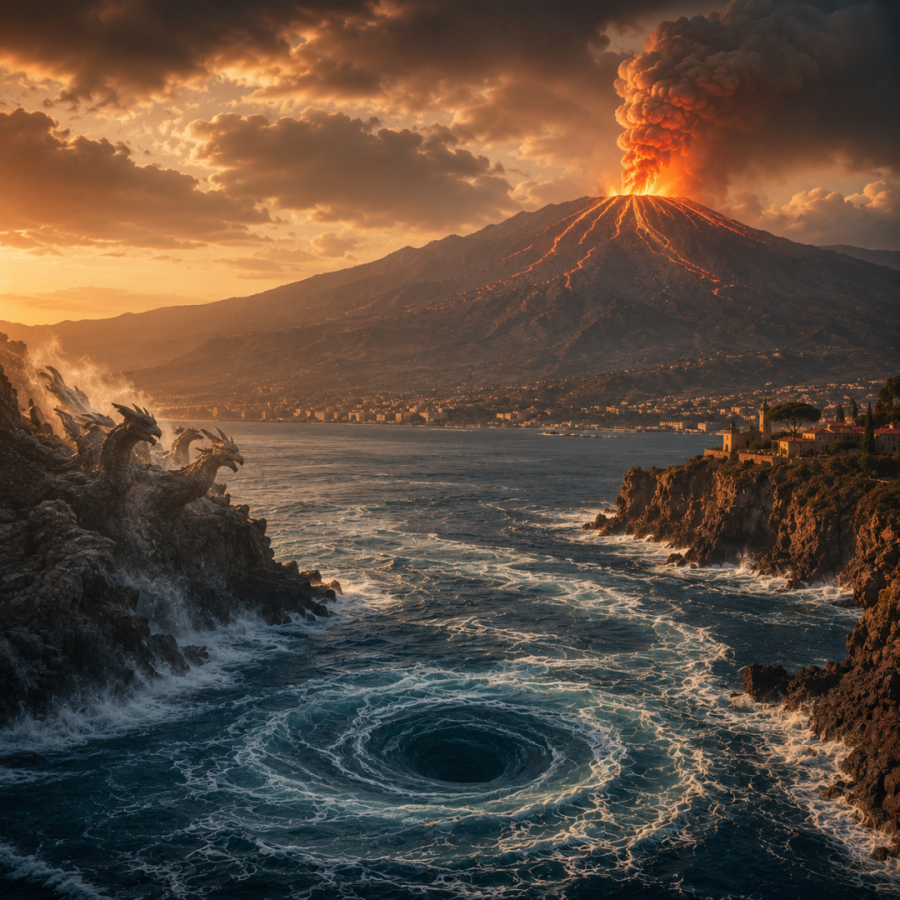
The volcano, the whirlpool and the monster were not three unrelated mysteries. They were three visible signs of one hidden world beneath Sicily.
This made the theory remarkably wide in scope. It attempted to explain not only why Etna burned, but also why the waters of the Strait roared, why waves appeared to fight each other and why ancient sailors imagined monsters living among them.
A Theory, Not a Confirmed Eruption
The first point to clarify is essential: this passage is not a detailed report of a single, securely dated eruption.
It does not describe a new fissure opening on Etna, a lava flow reaching a settlement or ash falling over a specific territory. It does not provide an exact year, the name of a consul or another chronological reference that would allow the event to be dated with confidence.
Instead, it offers a general explanation for the volcano’s apparently permanent fire.
The ancient writer was not primarily asking:
What happened during one particular eruption?
He was asking a broader question:
How can the fire of Mount Etna continue for so many centuries?
This distinction matters because later scholars have sometimes tried to extract evidence of a specific eruption from the passage. Such interpretations are worth discussing, but they must not be confused with what the surviving text explicitly says.
Historical caution
The source is valuable evidence for ancient ideas about Mount Etna. It is not, by itself, conclusive evidence for a precisely dated eruption at the beginning of the Roman imperial period.
Who Were Pompeius Trogus and Justin?
Pompeius Trogus
Pompeius Trogus was a Roman historian who lived between the second half of the first century BC and the beginning of the first century AD.
He came from Gallia Narbonensis, in southern Gaul, and belonged to a family connected with Roman administration and citizenship.
His major work was the Historiae Philippicae, a universal history in forty-four books. Rather than placing Rome at the centre of every event, Trogus devoted considerable attention to the Macedonian kingdoms, the Greek world and the wider histories of peoples surrounding the Mediterranean.
The original work has not survived in full.
Justin and the Epitome
What remains is known principally through an abridged version, or epitome, produced centuries later by Marcus Junianus Justinus, usually known simply as Justin.
Justin explained that he selected the passages he found most useful or interesting, leaving aside much of the rest. His method was therefore selective rather than a simple line-by-line summary.
This creates a historical difficulty.
When we read the chapter on Sicily and Mount Etna, we are encountering ideas associated with Trogus, but transmitted through the choices, language and possible interventions of Justin.
Scholars have consequently debated how closely the surviving account reflects the original wording and structure of the Historiae Philippicae.
About the source
The theory should therefore be described as preserved by Justin from the work of Pompeius Trogus, rather than treated as a direct manuscript written by Trogus that has reached us unchanged.
Sicily as a Hollow and Fragile Land
The theory begins with the physical structure of Sicily itself.
The island is imagined as having thin and fragile ground, penetrated by caves, channels, cracks and hidden passages. These openings make it possible for winds to enter the earth and circulate below the surface.
To a modern reader, the image may sound like Sicily was believed to rest upon an enormous underground flute.
Yet the idea served an important purpose: it moved the cause of volcanic activity into the physical structure of the land.
The fire was not explained only as the weapon of a god, the breath of a giant or the activity of a mythological forge. It was connected to features that ancient observers believed they could recognise:
- fractured rock
- natural caves
- openings that released gas and vapour
- underground noises
- the repeated emission of smoke, ash and fire
The proposed mechanism was wrong, but the search had become physical and geographical.
The writer was looking beneath the visible mountain for the hidden architecture that allowed it to function.
Sulphur, Bitumen and Underground Fire
The cavities beneath Sicily were not considered empty.
According to the theory, the subsoil contained sulphur, bitumen and other naturally combustible materials. When air entered the underground passages and came into contact with these substances, it generated or nourished fire.
The struggle between wind and underground heat was said to produce different visible effects:
- flames emerging from the mountain
- vapour released from fissures
- smoke rising from the interior
- sand and volcanic material expelled when the wind became more violent
- continuous combustion sustained beneath the volcano
From an ancient perspective, sulphur was a persuasive clue. Its smell, colour and presence around volcanic environments made it appear closely connected with burning ground.
Smoke and hot vapours also resembled the visible products of ordinary combustion. It therefore seemed reasonable to imagine Etna as a vast subterranean fire supplied with natural fuel.
Without knowledge of magma, ancient thinkers interpreted a volcano through the most familiar model available to them: a fire that required air and fuel.
Etna became something like an immense furnace, except that its bellows were hidden beneath Sicily and its chimney rose more than three kilometres above the sea.
How the Strait of Messina Supposedly Fed Mount Etna
The most original part of the theory is the role assigned to the Strait of Messina.
The narrow passage between Sicily and Calabria was famous in antiquity for complex currents, opposing waves and dangerous vortices. Water could appear to rush in different directions, sink into depressions and then rise again with extraordinary violence.
The ancient explanation connected these movements directly to the volcano.
The vortices supposedly drew wind down into the depths of the sea. That air remained trapped and compressed before travelling through subterranean channels beneath Sicily.
Eventually, it escaped through cracks and openings in the land, igniting or intensifying the combustible materials below Mount Etna.
In this model, the Strait behaved like a gigantic pump:
- the sea created violent vortices;
- the vortices dragged air downward;
- the air entered underground cavities;
- pressure forced it through fractures beneath Sicily;
- the wind fed the substances burning below Etna.
This also explained why the fire could last for centuries. An ordinary reserve of fuel should eventually be exhausted, but the continuous movement of the sea provided an equally continuous supply of air.
The ancient mechanism
The sea did not merely surround the volcano. In this theory, it actively sustained Etna by forcing wind into the hidden passages beneath the island.
Scylla and Charybdis: Myth Born from Natural Forces
The theory did not stop with geology. It also tried to explain mythology.
The Strait of Messina was one of the most feared maritime passages in the ancient Mediterranean. Sailors encountered strong currents, rapidly changing water and sounds amplified by cliffs, caves and moving waves.
To someone crossing the Strait in a small ancient vessel, these were not minor inconveniences.
Waves appeared to collide like opposing armies. Water seemed to fall into a great abyss before surging upward again. Deep noises rose from the sea, while the impact of water against rock could resemble growling or barking.
The account proposes that such phenomena contributed to the legends of Scylla and Charybdis.
Scylla
Scylla was imagined as a monstrous creature associated with the rocky Calabrian side of the Strait. In literary tradition, she seized sailors from passing ships and was sometimes described with multiple heads and barking dogs around her body.
The ancient naturalistic interpretation connected those terrifying sounds with waves striking caves and cliffs.
Charybdis
Charybdis represented the devouring whirlpool. She swallowed enormous quantities of water and later expelled them, threatening ships that passed too close.
The movements of currents in the Strait offered an observable foundation for the image of a sea creature capable of consuming the surrounding water.
Where sailors heard a monster barking, the natural philosopher heard waves striking rock. Where poets saw a mouth swallowing the sea, he saw a violent vortex.
This does not prove that the myths had only one origin. Myths develop through long traditions, storytelling and cultural exchange.
It does show, however, that ancient writers were willing to reinterpret monsters as imaginative responses to real natural dangers.
For more on the relationship between mythology and Sicilian landscapes, read our article on the gods, heroes and monsters of Sicily.
Etna and the Aeolian Islands
The same explanation was extended beyond Mount Etna to the volcanic islands north of Sicily.
The permanent or recurring fires of the Aeolian Islands were regarded as part of the same underground system of wind, water and combustible material.
This was particularly appropriate in an archipelago associated since antiquity with Aeolus, keeper of the winds.
In the ancient imagination, Etna and the Aeolian Islands were not isolated volcanic accidents. They occupied neighbouring parts of a broader landscape shaped by hidden fire and air moving below the Mediterranean.
Modern science does not support the proposed network of sea-driven winds and underground fuel.
Nevertheless, the regional perspective remains one of the most interesting features of the text. The author recognised that Etna, the Eolian volcanic islands and the Strait of Messina belonged to the same geographically restless corner of the Mediterranean.
A significant intuition
The physical explanation was mistaken, but the attempt to interpret several volcanic and marine phenomena as parts of a regional system was intellectually important.
Was There Really an Eruption Around AD 50?
A later scholarly interpretation proposed that the passage might contain a reference to an eruption around AD 50.
This possibility appears in historical attempts to build a chronology of Etna’s ancient activity from literary sources.
The argument is understandable. The text mentions Etna producing flame, vapour, smoke and large quantities of sand when underground wind becomes particularly violent.
Such language can sound like a description of eruptive behaviour.
However, several problems remain:
- the passage gives no explicit date;
- it describes the volcano’s activity as continuous over many centuries;
- it does not identify a particular vent or lava flow;
- it provides no clear geographical description of damage;
- the original work of Trogus is lost;
- the surviving text passed through the selective epitome of Justin.
It is therefore possible that memories or observations of real eruptive activity influenced the account. Etna was active, and ancient writers were certainly familiar with its emissions.
But the text cannot securely establish an eruption in or around AD 50.
Our conclusion
An eruption around AD 50 remains a historical hypothesis, not an event conclusively documented by this passage. The source is stronger as evidence for ancient volcanic theory than as evidence for a precise eruption date.
What the Ancient Theory Got Wrong and What It Understood
Modern volcanology explains Mount Etna very differently.
The volcano is not powered by sulphur and bitumen set alight by winds from the Strait. Nor does seawater provide the fuel required to keep the mountain burning.
Etna’s activity is driven by magma rising from depth through a complex plumbing system. The magma contains dissolved gases that expand as pressure decreases during ascent.
The movement of magma, the accumulation and release of gas, pressure changes, fractures and the structural features of the volcano all influence how and where eruptions occur.
What the Theory Got Wrong
- The Strait of Messina does not pump wind into Etna’s magma system.
- Seawater does not sustain volcanic fire beneath Sicily.
- Sulphur and bitumen are not the principal fuel of eruptions.
- Volcanic activity is not ordinary combustion taking place inside caves.
- Scylla and Charybdis cannot be reduced to a single physical explanation with certainty.
What It Understood
The ancient model nevertheless contained several perceptive observations.
- The cause lay beneath the surface. The volcano was understood as the visible expression of hidden processes.
- The ground contained fractures and passages. Although described incorrectly, pathways inside the earth were considered essential.
- Gas and pressure mattered. Wind was the wrong substance, but the role assigned to compressed gas was conceptually significant.
- Different emissions had a common cause. Flame, vapour, smoke and ejected material were treated as related volcanic manifestations.
- Etna belonged to a regional environment. The volcano was interpreted together with the Strait and the Aeolian Islands rather than as an isolated mountain.
It would be misleading to claim that Pompeius Trogus anticipated modern plate tectonics or magmatic science.
He did something more historically realistic and still impressive: he tried to replace a collection of supernatural events with a connected sequence of natural causes.
The ancient answer was wrong. The decision to search for a physical answer was not.
This search belongs to a long tradition of ancient reflection on Etna. Earlier authors such as Lucretius had also attempted to explain volcanic activity through winds, cavities, heat and material hidden beneath the mountain.
You can explore that tradition further in our article on Lucretius and the ancient Roman explanation of Mount Etna.
From Myth to Natural Philosophy
The importance of this account does not depend on proving an eruption around AD 50.
Its real value lies in the intellectual world it reveals.
Mount Etna could still belong to myth, poetry and divine geography. The Strait could still be inhabited by Scylla and Charybdis in the cultural imagination.
But beneath those stories, ancient writers were also searching for mechanisms.
They asked whether the barking monster could be the noise of waves against rock. They wondered whether the devouring creature might reflect a dangerous whirlpool. They imagined that the volcano’s smoke, vapour and fire originated in cavities hidden below the island.
In doing so, they began moving:
- from monsters to currents;
- from divine anger to physical processes;
- from isolated wonders to connected systems;
- from mythological description to natural philosophy.
The theory was shaped by the knowledge and assumptions of its period. It combined observation with speculation and accurate impressions with impossible mechanisms.
Yet the question at its centre remains the same one that continues to fascinate volcanologists, historians and visitors today:
What hidden forces can make a mountain burn for centuries?
Modern instruments now monitor earthquakes, deformation, gas emissions and the movement of magma beneath Etna.
The language has changed completely. The curiosity has not.
Seen from the Strait of Messina, with Etna rising in the distance and the Aeolian Islands beyond the northern horizon, it is easy to understand why ancient observers tried to unite fire, water, wind and myth within one extraordinary Sicilian landscape.
Explore the Landscapes Behind Sicily’s Ancient Stories
Discover Mount Etna’s lava fields, volcanic caves, craters and panoramic landscapes with local guides who combine natural history, geology and the stories that have surrounded the volcano for more than two thousand years.